Agentic Flow with AMD PACE
Sep 03, 2026

Introduction
AMD PACE (AMD Platform Aware Compute Engine) is an Open source Research and Development (RAD) project and a high-performance inference server that squeezes maximum throughput out of the AMD EPYC™ processor for Transformer workloads.
With this release, PACE takes its next major step: it graduates from being purely an inference engine to becoming a full agentic AI orchestrator. In this blog we describe why agentic workloads demand a new class of runtime, how PACE now uses LangGraph as its orchestration layer, and the four capabilities that make PACE a platform for building and serving agents:
- Deterministic Agent Execution and Benchmarking
- Flexible Deployment Across Local and Remote AI Infrastructure
- Native Support for Custom LangGraph Agents
- Optimized tool ops execution for end-to-end measurable performance gains
You can learn more about AMD PACE at https://github.com/amd/AMD-PACE.
Overview: From Modeling to Reasoning to Agents to Multi-Agents
Applied AI has climbed a steady ladder of autonomy. It started with modeling - training LLMs to predict the next token, where the goal was one good answer. Next came reasoning, as techniques like chain-of-thought let models break down problems, think through steps, and check their own work. That led to agents: models placed in a loop that can plan, call tools, and take real actions instead of just producing text. Today's frontier is multi-agent systems, where specialized agents - planners, researchers, coders, and critics - work together to solve problems no single agent could handle alone. Every step up this ladder adds capability by running hundreds of connected LLM calls, tool calls, and decisions. PACE now enables orchestration for agentic flow.
LangGraph
LangGraph has become one of the most popular frameworks for building stateful, controllable agents. Instead of treating an agent as an opaque while-loop, it models the agent as an explicit graph: nodes are units of work (an LLM call, a tool call, a decision); edges define the flow between them. This structure gives developers first-class support for loops, branching, human-in-the-loop interrupts and persistent memory, so a run can be paused, inspected, resumed, or fanned out to sub-agents. That mix of clear structure, and durable state is what makes LangGraph a natural orchestration layer, and it's the foundation PACE builds on.
PACE as an Orchestrator
Originally, PACE optimized every layer of the LLM pipeline - scheduling, KV cache, attention and MLP kernels, to deliver leadership inference performance on AMD EPYC CPUs. That high-performance core stays.
What's new is the scope: PACE now supports LangGraph as its native orchestration layer, turning it from a single-model inference server into an engine that runs entire agentic graphs end to end. PACE executes the LangGraph state machine, dispatching nodes, routing edges, threading shared state, and managing tool calls, while transparently mapping the LLM calls onto its own optimized backends or external accelerators. The result is one stack that unifies how agents are defined (LangGraph graphs) with how they run efficiently (PACE's platform-aware runtime). Developers write agents in familiar LangGraph, and PACE handles orchestration and scheduling - extending the platform-awareness that made PACE fast for inference into multi-step, multi-agent workflows. Around this orchestration core, PACE focuses on four features.
1. Deterministic Agent Execution and Benchmarking
Agentic systems are hard to debug and reproduce. Because they chain up many LLM calls, tool responses, and branches - each subject to sampling randomness; non-determinism can produce very different runs. This non-determinism leads to inconsistent results, making failures hard to reproduce, and evaluations hard to trust. PACE addresses this with a first-class replay mode: during a run, it records the full trace - graph state, prompts, sampling parameters, tool inputs/outputs, and event ordering, then re-executes the graph against that trace to reproduce the run step-for-step. This makes it easy to reproduce latency, defects and build reliable regression tests by turning agent benchmarking reliable and a repeatable, engineering-grade workflow. Additionally, PACE supports a profiling mode that provides detailed insight into the time spent across different operations in the agentic flow.
2. Flexible Deployment Across Local and Remote AI Infrastructure
PACE can orchestrate agents on CPU while offloading heavy inference to GPUs: PACE can connect to AMD Radeon™ graphics or AMD Instinct™ GPUs running vLLM or other inference serving engines with Open AI compatibility, dispatching model calls to them over the same interface. One can achieve the best of both worlds - PACE's efficient CPU orchestration and deterministic control plane, paired with high-throughput GPU inference, all behind one consistent API.
3. Native Support for Custom LangGraph
PACE enables bringing your own LangGraph workflows and using our example graphs and reference implementations to build and accelerate agentic applications.
4. Optimized Tool Execution for Agentic Benchmarks
To make agent quality and performance measurable, the current version of agentic workflow supports two leading agentic benchmarks: WebVoyager and GAIA.
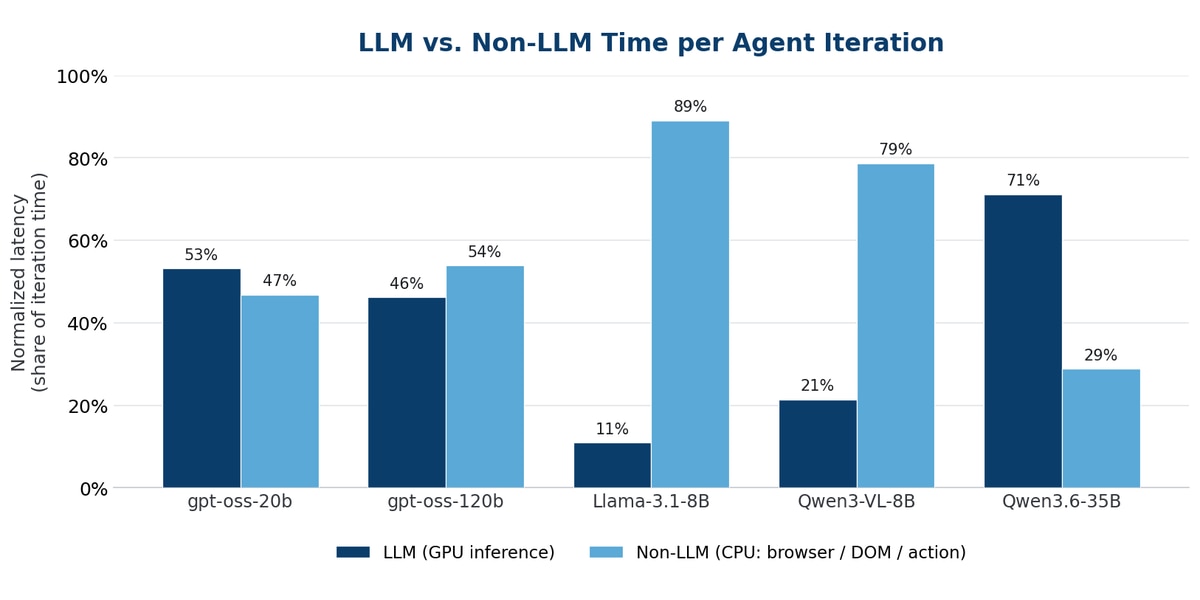
WebVoyager tests web-browsing agents on realistic, end-to-end tasks on live websites - searching, navigating, filling forms, and extracting information from dynamic pages, often using a multimodal (screenshot + DOM) view of the browser. It stresses the skills that matter for real-world autonomy: long-horizon planning, robust tool use, and recovery from unexpected page states. Figure 1 shows the normalized time spent on non-LLM operations across page weights (cost of observing a page) and the overhead increases with page weights.
GAIA (General AI Assistants) tests general assistant reasoning through questions that are simple for humans but require agents to combine multi-step reasoning, tool use, web search, file handling, and multimodal understanding.
Finally, PACE treats an agent as a single end-to-end flow to optimize. Because it owns the entire LangGraph execution - orchestration, scheduling, inference, and tool dispatch; PACE can optimize across the full graph.
PACE currently enables orchestration across WebVoyager and GAIA tasks and enables configuration to choose
- Models and devices or Open AI API
- Cores per CPU
- Parallel workers
Evaluation
Feature |
Specification |
CPU |
AMD EPYC™ 9755 Series server CPUs, (“Turin”) |
Architecture |
Zen 5 |
Cores |
128 cores per socket |
RAM |
1.5 TB |
Precision |
BF16 |
Sockets |
2 |
Feature |
Specification |
GPU |
AMD Radeon™ AI PRO R9700S |
Architecture |
AMD RDNA™ 4 |
Page weight |
Normalized Page Weight |
Operator Level Speedup |
End to End Speedup |
Very light |
1x |
7.2x |
1.02x |
Light |
2.6x |
8.8x |
1.04x |
Medium |
5.9x |
10.0× |
1.08× |
Heavy |
15.8x |
9.1x |
1.21x |
Very heavy |
68.2x |
7.9x |
2.20x |
Agentic loops repeatedly invoke tools, observe their output, and call the LLM. As Table 2 shows, PACE significantly reduces the time spent observing page state, which translates into an end-to-end performance gain of 1.02×–2.20× on WebVoyager tasks. Here, page weight denotes the cost of observing a page — i.e., serializing its DOM/accessibility tree; normalized to the lightest task in the set (=1×); heavier pages have larger DOM trees and therefore higher observation cost. The gain grows with page weight because observation dominates a larger share of total task time on heavy pages. See the AMD PACE repository for sample tasks and configurations; further optimizations are ongoing.
Applicability of PACE: PACE can further be applied to characterize agentic workflows, such as determining the optimal choice between an LLM and an SLM for a given benchmark.
Work in Progress: Subsequent releases are expected to add features such as semantic-routing-based model switching and support for recent Qwen models.
Conclusion
In summary, PACE enables agentic AI orchestrators. By implementing LangGraph on top of its platform-aware runtime, PACE unifies how agents are defined with how they are executed efficiently on AMD hardware. Its four pillars - deterministic execution, flexible deployment, native custom LangGraph support and optimized tool execution are demonstrated with real performance gains; together provide PACE the required foundation for the next generation of autonomous and multi-agent AI systems. As the field continues its climb from modeling to reasoning agents to multi-agent collaboration, PACE aims to be the efficient, reliable engine underneath it all.
Resources
- AMD PACE GitHub repository
- vLLM project
- Original AMD PACE blog
- 5th Gen AMD EPYC processor architecture white paper
- AMD EPYC 9005 Series processor data sheet
Footnotes
Footnote
A system configured with an AMD EPYC™ 9755 series processor and AMD Radeon™ AI PRO R9700S was used to evaluate AMD PACE end to end orchestration. Testing done by AMD on 21st August. Results may vary based on configuration, usage, software version, and optimizations. SYSTEM CONFIGURATION: Supermicro; AMD EPYC 9755 128-Core Processor (2 sockets, 128 cores per socket, 2 threads per core); 1 NUMA node per socket; 1536 GB memory (24 DIMMs, 6400 MT/s, 64 GiB/DIMM); Ubuntu 24.04.2 LTS, kernel 6.8.0-86-generic.
Footnotes
Footnote
A system configured with an AMD EPYC™ 9755 series processor and AMD Radeon™ AI PRO R9700S was used to evaluate AMD PACE end to end orchestration. Testing done by AMD on 21st August. Results may vary based on configuration, usage, software version, and optimizations. SYSTEM CONFIGURATION: Supermicro; AMD EPYC 9755 128-Core Processor (2 sockets, 128 cores per socket, 2 threads per core); 1 NUMA node per socket; 1536 GB memory (24 DIMMs, 6400 MT/s, 64 GiB/DIMM); Ubuntu 24.04.2 LTS, kernel 6.8.0-86-generic.

Related Blogs
-
Meet the Next AMD Ryzen™ AI Halo
Meet the next AMD Ryzen™ AI Halo developer platform, powered by the AMD Ryzen™ AI Max+ PRO 495 processor. Run larger local LLMs, up to 300B parameters, thanks to the 192GB of unified memory that comes on the new platform.
October 12, 2026
-
AMD AI NIC™ Technology Driving AI-Ready Ethernet
Learn how AMD AI NIC™ technology helps organizations build AI-ready Ethernet networks with open standards, programmability, and transport innovation.
October 11, 2026
-
Kimi K3 on AMD Instinct GPUs with TokenSpeed
TokenSpeed delivers fast, agentic LLM inference on AMD Instinct™ MI355X GPUs, with optimized kernels and leading Kimi K3 performance.
October 09, 2026
-
scikit workloads with AOCL Data Analytics
Accelerate supported scikit-learn workloads with AOCL-Data Analytics while keeping your existing Python code and familiar scikit-learn APIs.
October 09, 2026
-
MangoBoost Delivers Open AI Models Powered by AMD
Mango Inference a serverless inference service providing production-ready access to open models powered by AMD Instinct™ GPUs and AMD ROCm™ software
October 09, 2026
-
MoRI UMBP Empowers AMD Instinct GPUs
See how UMBP, MoRI and SGLang optimize KV cache reuse to boost AMD Instinct™ MI355X GPU agentic AI performance and cost efficiency
October 09, 2026
-
Pre-Training Hybrid LLMs from Scratch in Primus on AMD Instinct™ GPUs — ROCm Blogs
Pre-train hybrid LLMs mixing MLA attention with Gated DeltaNet, Kimi Delta Attention and Mamba2 mixers on AMD Instinct MI355X GPUs, with open recipes.
October 07, 2026
-
DI Series: Serving Kimi-K3 MXFP4 Wide-EP Disaggregated on AMD Instinct MI300X and MI325X — ROCm Blogs
Learn how to serve a 1.4 TiB Kimi-K3 MXFP4 mixture-of-experts model disaggregated across AMD Instinct MI300X and MI325X GPUs.
October 07, 2026