The Many Aspects of Inference Performance
Mar 18, 2026

Inference Performance is Multifaceted
At GTC 2026, NVIDIA showed an inference performance comparison based on benchmarking data from SemiAnalysis "InferenceX", showing GB300 NVL72 (FP4, MTP) delivering 50X higher tokens-per-watt and 35X lower cost-per-token than last-generation Hopper (FP8) and shows the "competition" in-between. In fact, when comparing the same operating modes, AMD Instinct™ MI355X GPU often delivers comparable or better results than GB300 NVL72.
What is InferenceX? SemiAnalysis InferenceX is an independent inference benchmarking framework that tests NVIDIA and AMD GPUs across a very broad universe of configurations. It sweeps across combinations of concurrency levels, input and output sequence lengths, data types, speculative decode settings, serving frameworks, and deployment topologies. This breadth is the point; no single operating point can tell the whole story.
Within this universe, some configurations match the most common real-world deployments. Others suit specialized workloads like long-context processing or batch jobs. Some are technically valid, but not used in practice.
Inference performance depends on a wide set of parameters that shift the outcome materially:
- Concurrency and batch size
- Data type: INT4, FP4, FP8, BF16, FP16
- Speculative decode and Multi-Token Prediction (MTP) settings
- Framework: open-source SGLang, vLLM, or proprietary closed source (TRT-LLM)
- Serving topology: single node vs. multi-node disaggregated, rack-scale
- and other parameters such as input and output sequence length (ISL/OSL)
Every one of these is a software optimization point. Vendors can find a configuration that shows a large advantage. The right question is not which configuration makes a GPU look best, but rather what the cost per token is for a given workload and interactivity target.
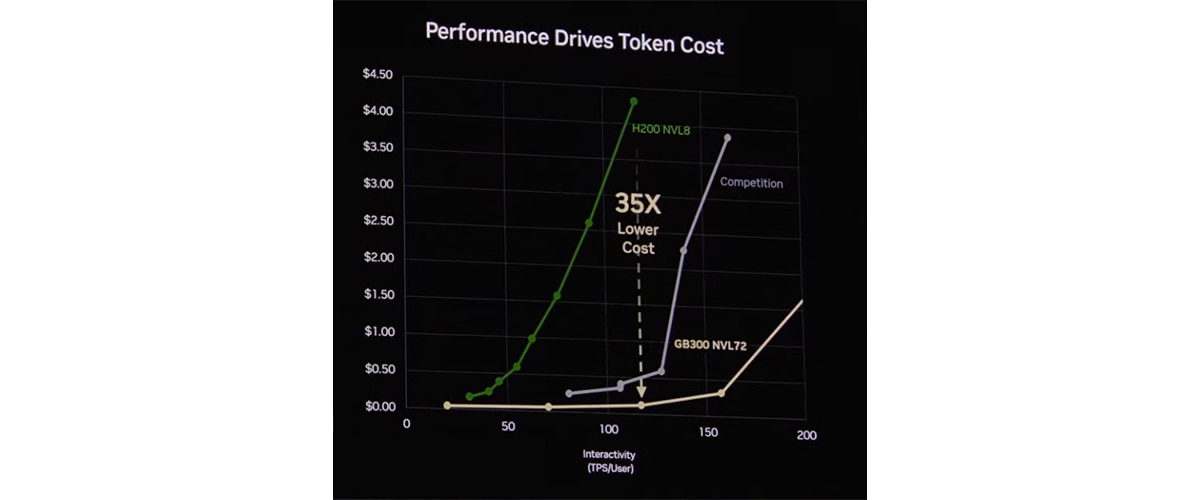
Unpacking the GTC benchmark
At GTC, NVIDIA's cost-per-million-token benchmark used FP4, MTP=3, and March 7 data on DeepSeek 1k/1k: each choice favors NVIDIA's result.
MTP is a genuine throughput technique, but gains vary by dataset and configuration. NVIDIA's benchmark used MTP=3; AMD defaults to MTP=1 at this time. Data type also matters: this data point showed FP4 but FP8 is a also common production choice.
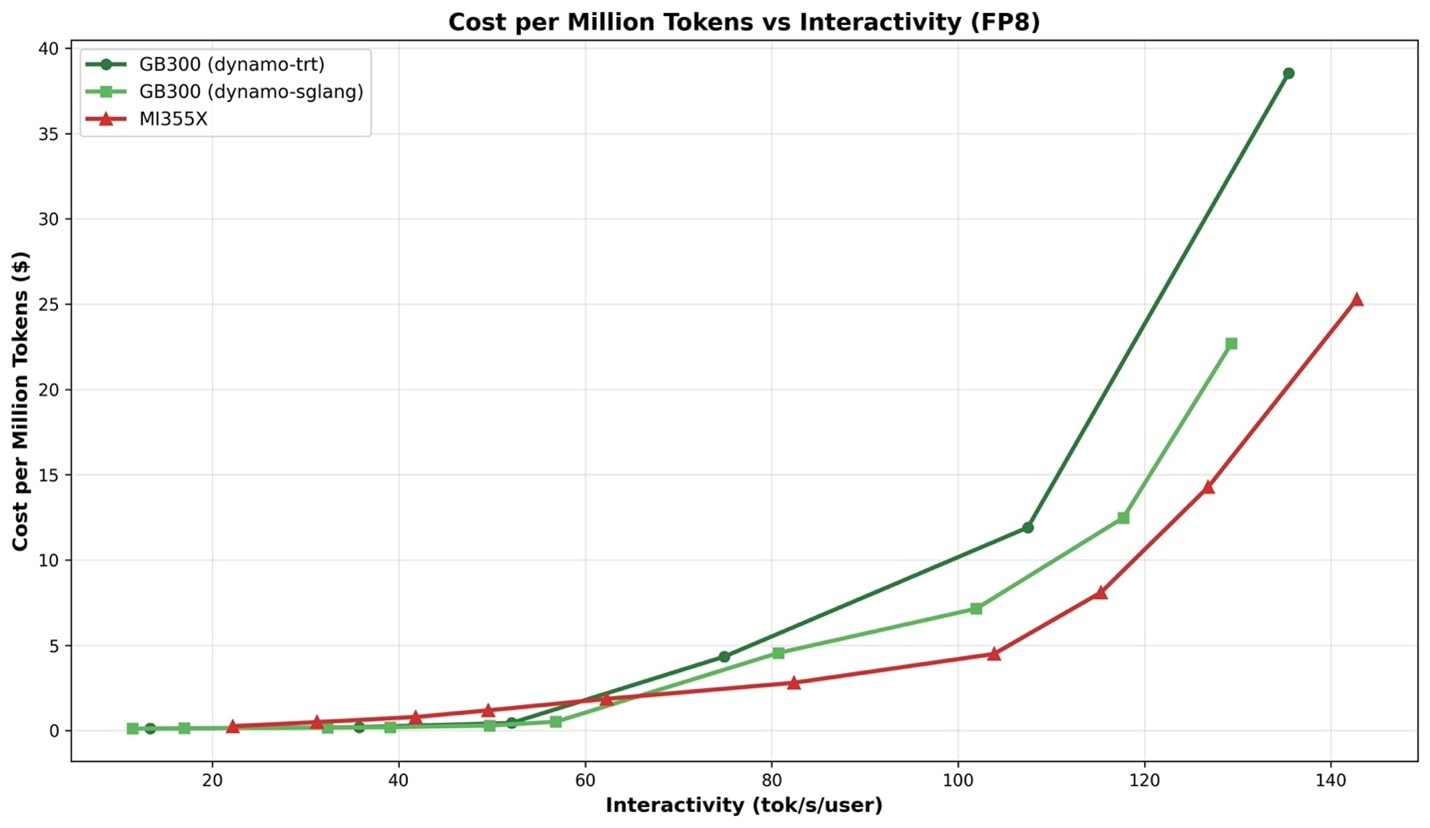
On equal footing, MTP off and FP8 for both, MI355X cost-per-token is materially lower than GB300 NVL72 at high concurrency, 60+ TPS/user (Figure 1).
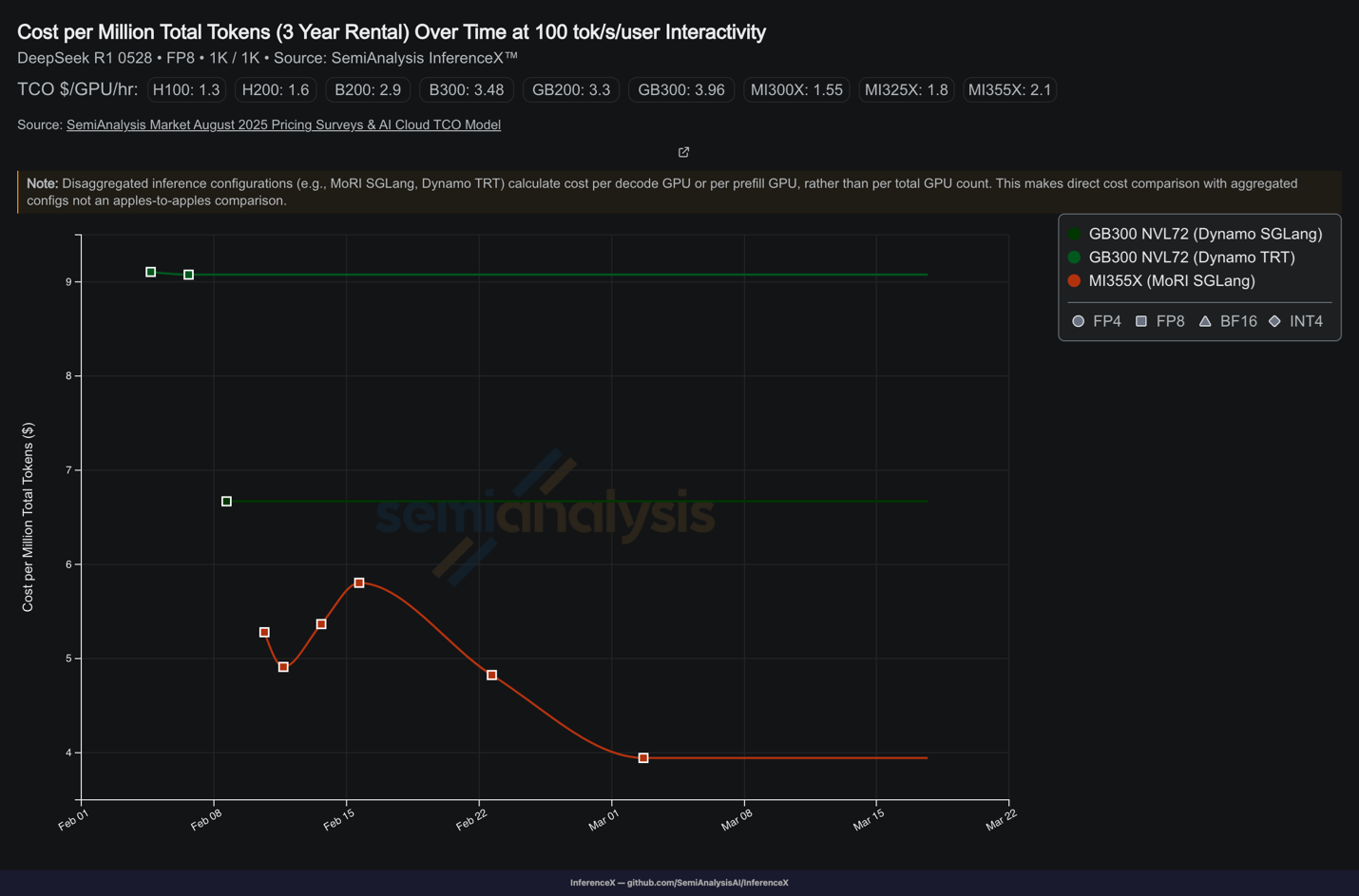
To illustrate the impact of software optimization on cost per token: since February, MI355X GPU cost per token has dropped significantly, while GB300 NVL72 remains higher and unchanged (Figure 2).
Upcoming Innovations
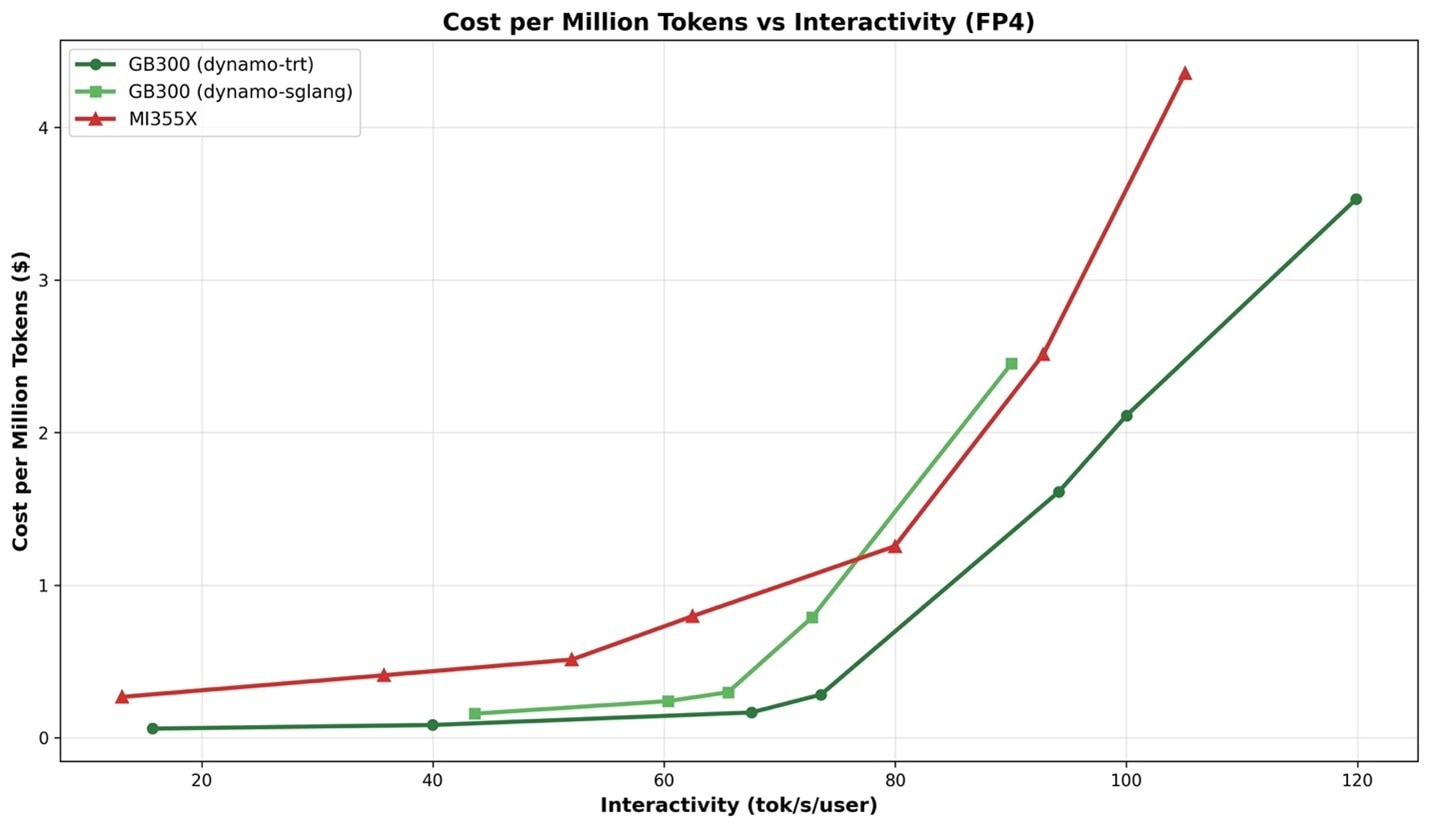
Optimized FP4 for Distributed inference on AMD Instinct MI350 Series is coming end of March. The initial focus of AMD for Distributed Inference was on FP8. However, for FP4, MI355X SGLang is already ahead of GB300 SGLang at 80+ TPS/user on unoptimized FP4 (Figure 3), with further optimizations expected by the end of March.
Rack scale is coming in 2H with AMD Helios (MI450). Rack-scale architectures with higher scale-up domains provide real value at low interactivity, where larger batch sizes and higher GPU parallelism help most. rack-scale answer from AMD is “Helios” with MI450 GPUs, planned for 2H 2026, targeting exactly that regime.
The bottom line
What you run for inference depends on your workload characteristics and requirements. The right evaluation is to run your model, with your context length, latency target, and concurrency, on both platforms. That is the benchmark AMD is ready to run.
Contact your AMD account team to schedule a side-by-side evaluation.

Related Blogs
-
NeuroSpark Expands AI Compute Choice with AMD
NeuroSpark uses AMD Instinct GPUs and ROCm software on OCI to deliver flexible, cost-effective AI training and inference
October 23, 2026
-
Sovereign AI for European Customer Conversations
LeadDesk, QuTwo, and AMD Silo AI collaborate on a sovereign AI stack that brings near-frontier, open-weight models to European customer conversations.
October 22, 2026
-
Micro-World 2: Streaming Real-time Interactive World Model — ROCm Blogs
This blog demonstrates how Micro-World 2 combines precisely annotated action data, four-step diffusion distillation, and ROCm-optimized inference to deliver controllable, long-horizon, real-time world generation on a single AMD Instinct GPU through a fully open-source pipeline.
October 20, 2026
-
MoE Training Optimization with Primus — ROCm Blogs
Learn how to speed up MoE training on AMD Instinct GPUs with Primus: a fused MoE megakernel, FP8/MXFP8 expert GEMMs, and training-at-scale tuning.
October 20, 2026
-
Optimizing World Action Models on AMD GPUs — ROCm Blogs
Speed up World Action Models on AMD GPUs with GEAK kernels, fewer denoising steps, and latent actions, cutting FastWAM latency 25× at about 97 percent success.
October 20, 2026
-
Bringing Ultra-Fast, Interactive LLM Inference to AMD Instinct™ MI355X GPUs — ROCm Blogs
Accelerate single-request LLM inference on AMD Instinct MI355X with megakernels, speculative decoding, and MXFP4 for 1.9-3.3x faster decode.
October 19, 2026
-
From Prompt to Playback: Nunchux Turns AMD Instinct™ GPU Performance into Responsive Video AI
See how AMD Instinct™ MI355X GPUs and AMD ROCm™ software enable faster-than-playback MiniMax-H3 video generation.
October 19, 2026
-
From AI That Answers to AI That Acts
Why physical AI requires a new definition of performance – one built around the whole system, not peak compute.
October 19, 2026