It’s Not Even a Competition

Switch from Intel Xeon® to AMD EPYC™ Server CPUs for a fast time-to-value: save space and power, easy migration, a stable roadmap, and out-of-the-box on‑prem, cloud, and hybrid deployments.

Up to
43%
more concurrent CPU Inference users
(Llama3.1-8B)¹
Up to
25%
lower Memory Costs
(When consolidating 2P to 1P servers with per-socket licensing)²
Up to
50%
lower licensing costs
(When consolidating 2P to 1P servers with per-socket licensing)²

Do More with Less

A single AMD EPYC 9005 CPU-based server can do the work of eight 2nd Gen Intel Xeon Platinum servers3

Black fade

Switching to AMD is Easy

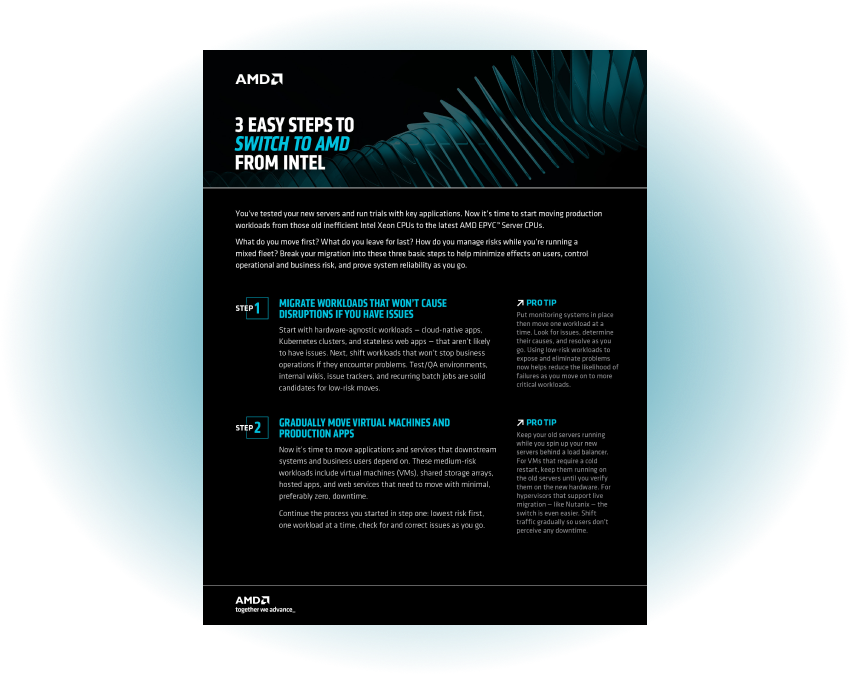
Break your migration into three basic steps to help minimize effects on users, control operational and business risk, and prove system reliability as you go.

Switch to AMD Migration Guide
Benefits of Switching whitepaper

Experience the Benefits of Switching

Address migration myths, slash licensing costs, and execute a strategic refresh that pays for itself.

Frequently Asked Questions About Switching

Migrate from Intel Xeon to AMD EPYC™ Server CPUs without modifications using x86 compatibility, VAMT tools, and modern hypervisors to maintain constant application availability.

AMD EPYC Server CPU is available in about 1600 cloud instances for leadership across workloads, with broad migration support from service providers.  

Streamline migration with VAMT, enabling up to 8x consolidation when upgrading to AMD.3 See how VAMT can help break down the barriers when migrating between processor architectures. 

Built-in at the silicon level, AMD Infinity Guard offers the advanced capabilities required to help defend against internal and external threats and keep your data safe.4 AMD helps protect your data with features like Secure Encrypted Virtualization (SEV), the most mature and widely deployed confidential computing technology in the industry.5

Build with an open-source software ecosystem that runs across both Server CPUs and GPUs, ensuring your AI development remains flexible and high-performing. This allows you to scale using the industry-standard tools you already use without proprietary lock-in. 

Instantly see your personal consolidations and savings with AMD EPYC TCO Estimators. 

Compare 4th and 5th Generation AMD EPYC Server CPU Performance with Intel Xeon 6

24 Core CPUs
5th Gen AMD EPYC 9275F
825
4th Gen AMD EPYC 9274F
675
Intel Xeon 6527P
606
16 Core CPUs
5th Gen AMD EPYC 9175F
618
4th Gen AMD EPYC 9148X
472
Intel Xeon 6724P
403
8 Core CPUs
5th Gen AMD EPYC 9015
245
Intel Xeon 6 6714P
210

Based on SPECrate®2017_int_base scores from spec.org as of December 11, 2025. Each core count features the highest-performing SKU in the processor series. See notes 6 and 7 for details. 

64 Core CPUs
5th Gen AMD EPYC 9575F
1760
4th Gen AMD EPYC 9554
1420
Intel Xeon 6767P
1370
48 Core CPUs
5th Gen AMD EPYC 9475F
1470
4th Gen AMD EPYC 9474F
1200
Intel Xeon 6747P
1140
32 Core CPUs
5th Gen AMD EPYC 9375F
1070
4th Gen AMD EPYC 9374F
876
Intel Xeon 6737P
770

Based on SPECrate®2017_int_base scores from spec.org as of December 11, 2025. Each core count features the highest-performing SKU in the processor series. See notes 6 and 7 for details. 

128 Core CPUs
5th Gen AMD EPYC 9755
2850
Intel Xeon 6980P
2510
96 Core CPUs
5th Gen AMD EPYC 9655
2200
4th Gen AMD EPYC 9684X
1890
Intel Xeon 6787P
1670

Based on SPECrate®2017_int_base scores from spec.org as of December 11, 2025. Each core count features the highest-performing SKU in the processor series. See notes 6 and 7 for details. 

192 Core CPUs
5th Gen AMD EPYC 9965
3230
Intel Xeon 6 (N/A)
160 Core CPUs
5th Gen AMD EPYC 9845
2710
Intel Xeon 6780E (N/A)
144 Core CPUs
5th Gen AMD EPYC 9825
2660
Intel Xeon 6780E
1420

Based on SPECrate®2017_int_base scores from spec.org as of December 11, 2025. Each core count features the highest-performing SKU in the processor series. See notes 6 and 7 for details. 

Black fade
Black fade

AMD EPYC Delivers the Industry’s Uncompromised x86 Architecture

When it comes to the x86 architecture, AMD sticks to what works. You can find the same, uncompromised set of instructions and features across all AMD EPYC Server CPU generations.  


AMD EPYC™ 9005 Server CPUs

Out of the Box x86 Performance, Seamless Integration

Intel® Xeon 6 CPUs
Split Architecture, Mixed Features, Challenging Integration

Architecture Strategy

Single ISA
Common Zen 5 cores on all EPYC 9005 platforms
Cross-compatible CPUs

Split architecture

Must choose performance cores or efficiency cores

Can’t mix architectures at the server level

Portfolio

8 cores to 192 cores

8 cores to 144 cores*

Feature Availability

Unified feature set for leadership performance and efficiency

More complexity: Broad model choices require compromise on features, performance, memory, efficiency, cost, and more

AVX512

Yes, on all models

Only on Performance core models

Simultaneous Multithreading (SMT)

Yes, on all models

Only on Performance cores models

Deployment Strategy

Unified feature set simplifies deployment

Mixed features require tuning, tweaking, and optimizing to run on a mix of “engines” and aligning deployment to unique per-system capabilities.

*Intel Xeon product information as of Q425 https://www.intel.com/content/www/us/en/ark/products/series/240357/intel-xeon-6-processors.html

Case Studies

Dynamic visualization of a network
Unmodified AMD EPYC Server CPUs Run Llama Faster than Intel AMX

Standard 4th Generation AMD EPYC 9654 Server CPUs outperform 5th Gen Intel Xeon Platinum 8592+ on Llama 2 and Llama 3 inference workloads, even with Intel® AMX active.6

Abstract digital data flow
AMD EPYC Powered MaxLinear Panther III Bests Intel® QAT

A MaxLinear Panther III accelerator paired with a 4th Generation AMD EPYC 9654 server outpaces two Intel Platinum 8472C servers with Intel™ QAT crypto and compression accelerators by up to 13X on L9 DEFLATE benchmarks.7

Swisscom Case Study
Swisscom Lowers Power Consumption 24%

By switching its cloud to single-socket servers powered by 64-core 4th Gen AMD EPYC 9554P Server CPUs, Swisscom uses 55% fewer watts per vCPU than an Intel Xeon-powered server.8

Black fade

Resources

Product Selector and Estimation Tools

Compare AMD EPYC Server CPUs with Intel Xeon, calculate potential greenhouse gas emissions, and estimate total cost of ownership.


Connect with AMD 

Sign up for AMD news and announcements including upcoming events and webinars.
Ask for an AMD EPYC Server CPU sales expert to contact you.
Footnotes

*Forbes. ©2026 Forbes Media LLC. All rights reserved. Used under license. 

  1. 9xx5-255: Llama3.1-8B throughput results based on AMD internal testing as of 10/16/2025. Configurations: llama3.1-8B, vLLM, python 3.10, TPOT max 100ms, BF16, input/output lengths: [128/256, 256/512, 1024/1024] 1P AMD EPYC 9555 (64 Total Cores, reference system, 768GB 12x128GB DDR5-6400, BIOS RVOT1003C, Ubuntu® 22.04 | 6.8.0-84-generic, SMT=OFF, Determinism=power, Mitigations=off), vLLM 0.9.2, ZenDNN 5.1.0, NPS1 1P Intel Xeon 6767P (64 Total Cores, production system, 512GB 8x64GB MRDIMM at 8000 MT/s, BIOS IHE110U-1.20 (AMX on), Ubuntu 24.04 | 6.8.0-84-generic, SMT=OFF, Performance Bias, Mitigations=off), vLLM 0.9.1, IPEX 2.7, NPS1, SNC OFF Results: input output prompts6767P throughput6767P prompts9655 throughput9655 128 256 60 435.98 76 680.58 256 512 51 419.63 68 586.18 1024 1024 30 249.53 43 378.03 Results may vary due to factors including system configurations, software versions, and BIOS settings. 
  2. 9xx5-277: SPECrate®2017_int_base comparison based on published scores from www.spec.org as of 12/11/2025. Results and configurations below are in the format of: [processor], [cores], [TDP], [1Ku price in USD], [Memory Configuration], [SPECrate®2017_int_base score], [SPECrate®2017_int_base score / CPU W], [SPECrate®2017_int_base score / 1Ku price in USD], [Link to score] 1P AMD EPYC 9555, 64C Total, 360W Total, $7973 USD Total, 12x64GB DDR5-6400, 883, 2.453, 0.111, https://www.spec.org/cpu2017/results/res2025q4/cpu2017-20251020-50043.html 2P Intel Xeon 6745P, 64C Total, 600W Total, $10500 USD Total, 16x64GB DDR5-6400, 815, 1.358, 0.078, https://www.spec.org/cpu2017/results/res2025q3/cpu2017-20250811-49362.html Memory cost savings based on comparing quantities of identical memory (same price per unit) between servers, per the published SPECrate®2017_int_base results. Comparing 12x64GB DDR5-6400 vs 16x64GB DDR5-6400. Results may vary based on factors including but not limited to system configurations, software versions, and BIOS settings. SPEC®, SPEC CPU®, and SPECrate® are registered trademarks of the Standard Performance Evaluation Corporation. See www.spec.org for more information. CPU specifications from ark.intel.com.
  3.  9xxTCO-018: This scenario contains many assumptions and estimates and, while based on AMD internal research and best approximations, should be considered an example for information purposes only, and not used as a basis for decision making over actual testing. The AMD Server & Greenhouse Gas Emissions TCO (total cost of ownership) Estimator Tool - version 1.53, compares the selected AMD EPYC™ and Intel® Xeon® CPU based server solutions required to deliver a TOTAL_PERFORMANCE of 391,000 units of SPECrate2017_int_base performance as of September 30, 2025. This analysis compares a 2P AMD 192 core EPYC_9965 powered server with a SPECrate2017_int_base score of 3230,
    https://spec.org/cpu2017/results/res2025q2/cpu2017-20250324-47086.pdf;  compared to a 2P Intel Xeon 128 core Xeon_6980P based server with a SPECrate2017_int_base score of 2510, https://spec.org/cpu2017/results/res2025q2/cpu2017-20250324-47099.pdf;
    versus legacy 2P Intel Xeon 28 core Platinum_8280 based server with a SPECrate2017_int_base score of 391,
    https://spec.org/cpu2017/results/res2020q3/cpu2017-20200915-23984.pdf 
    Environmental impact estimates made leveraging data from the 2025 International Country Specific Electricity Factors and can be found at https://www.carbondi.com/#electricity-factors/ and the US EPA Greenhouse Gas Equivalencies Calculator used in this analysis was sourced on 09/04/2024 and can be found at https://www.epa.gov/energy/greenhouse-gas-equivalencies-calculator.
    For additional details, see
    https://www.amd.com/en/legal/claims/epyc.html#q=9xx5TCO-018.
  4. GD-183A: AMD Infinity Guard features vary by EPYC™ Processor generations and/or series. Infinity Guard security features must be enabled by server OEMs and/or Cloud Service Providers to operate. Check with your OEM or provider to confirm support of these features. Learn more about Infinity Guard at https://www.amd.com/en/technologies/infinity-guard. GD-183A.
  5. EPYC-056: Confidential Computing on EPYC is enabled by the SEV security feature, which was introduced with 1st Generation EPYC in 2017. 2nd Gen EPYC powered the first confidential computing cloud instance in Google Cloud in 2020. EPYC: powers the highest number of confidential VM options available on all major CSP; Supports both host and guest in the Linux® Kernel; Is available on all major Linux Distributions; Has support on VMware®; supports confidential containers.
  6. AMD, Leadership Natural Language AI Performance
  7. AMD, 4th Gen AMD EPYC™ Processors Offer Leadership Maxlinear Compression Performance
  8. Performance and cost savings claims are provided by Swisscom and have not been independently verified by AMD. Performance and its cost benefits are impacted by a variety of variables. Results herein are specific to Swisscom and may not be typical. GD-181