Day 0 Support for Xiaomi MiMo-V2.5-Pro on AMD Instinct GPUs
Apr 28, 2026
We are excited to announce Day 0 support for Xiaomi MiMo-V2.5-Pro, the most capable model Xiaomi has ever built, running natively on AMD Instinct™ GPUs. This technical blog presents a Day 0 deployment walkthrough for Xiaomi’s brand new MiMo model on the AMD Instinct GPU by leveraging AMD ROCm™ 7 software and SGLang/ATOM upstream optimizations.
MiMo-V2.5 Series enters public beta on April 23, with general availability and open-source release following on April 28. As one of the first silicon partners to deliver optimized support from day one, AMD is ready for developers on launch.
What MiMo-V2.5-Pro Is
Purpose-built for the hardest problems in AI, MiMo-V2.5-Pro rivals the world's top agent models, Claude Opus 4.6 and GPT-5.4 among them; across general-purpose agent tasks, complex software engineering, and long-horizon execution. A major leap from its predecessor, the new model delivers sharper instruction-following in agentic workflows, picking up on implicit requirements in context and maintaining logical consistency over extended sessions.
Enterprise teams will find a natural fit for large-scale code generation, deep data analysis, and tight integration with agent frameworks like OpenClaw, Hermes Agent, and Claude Code.
Optimized for AMD Silicon
AMD has tuned MiMo-V2.5-Pro end-to-end on proprietary silicon, achieving high-throughput, low-latency inference that holds up under heavy workloads and million-token contexts.
- Hardware: With 288 GB on-chip memory and 8 TB/s bandwidth, AMD Instinct MI355X comfortably drives inference at MiMo-V2.5-Pro's full 1T-parameter scale and 1M-token context window.
- Software Stack: AMD ROCm software offers native compatibility with vLLM, PyTorch, SGLang, and other widely adopted AI frameworks.
- Key Optimizations: MiMo-V2.5-Pro is day-0 supported in the AMD ATOM inference engine with AITER-powered efficient kernels, along with multiple kernel fusions, FP8 KV cache optimizations, Multi-Token Prediction with an EAGLE proposer, and piecewise torch.compile. It also day-0 supports SpecV2-based multi-layer EAGLE inference with SGLang.
Deployment Guide
Run MiMo-V2.5-Pro with ATOM on AMD Instinct GPUs
Step 1: Get Started with AMD ATOM
Please use the latest pre-built upstream docker image for the MI355x GPU
		docker run -d -it \
    --ipc=host \
    --network=host \
    --privileged \
    --cap-add=CAP_SYS_ADMIN \
    --device=/dev/kfd \
    --device=/dev/dri \
    --device=/dev/mem \
    --group-add video \
    --cap-add=SYS_PTRACE \
    --security-opt seccomp=unconfined \
    --shm-size 32G \
    --entrypoint "/bin/bash" \
    --name mimov25pro \
    aigmkt/mimo-v2.5-pro-atom:latest
Step 2: Start ATOM serving
		python -m atom.entrypoints.openai_server \
 --model XiaomiMiMo/MiMo-V2.5-Pro \
 -tp 8\
 --trust-remote-code \
 --kv_cache_dtype fp8
Step 3: Accuracy Evaluation with lm_eval
		lm_eval --model local-completions \
  --model_args model= XiaomiMiMo/MiMo-V2.5-Pro,base_url=http://localhost:8000/v1/completions,num_concurrent=64,max_retries=3,tokenized_requests=False \
  --tasks gsm8k \
  --num_fewshot 5

Run MiMo-v2.5-Pro with SGLang on AMD Instinct GPUs
Step 1: Get Started with SGLang
Please use the latest pre-built upstream docker image for the MI355x GPU
		docker run -d -it \
    --ipc=host \
    --network=host \
    --privileged \
    --cap-add=CAP_SYS_ADMIN \
    --device=/dev/kfd \
    --device=/dev/dri \
    --device=/dev/mem \
    --group-add video \
    --cap-add=SYS_PTRACE \
    --security-opt seccomp=unconfined \
    --shm-size 32G \
    --entrypoint "/bin/bash" \
    --name mimov2.5pro \
    aigmkt/mimo-v2.5-pro-sglang:latest
Step 2: Start SGLang serving
		export SGLANG_ENABLE_SPEC_V2=1
python3 -m sglang.launch_server \
  --model-path XiaomiMiMo/MiMo-V2.5-Pro \
  --tp-size 8 \
  --decode-log-interval 1 \
  --host 0.0.0.0 \
  --port 30000 \
  --trust-remote-code \
  --disable-radix-cache \
  --watchdog-timeout 1000000 \
  --mem-fraction-static 0.8 \
  --chunked-prefill-size 131072 \
  --max-running-requests 64 \
  --speculative-algorithm EAGLE \
  --speculative-num-steps 3 \
  --speculative-eagle-topk 1 \
  --speculative-num-draft-tokens 4 \
  --enable-multi-layer-eagle \
  --attention-backend triton
Step 3: Chat Completions API
		curl http://localhost:30000/v1/chat/completions \
    -H "Content-Type: application/json" \
    -d '{
        "messages": [{"role": "user", "content": "What is the history of Beijing?"}],
        "max_tokens": 512,
        "temperature": 0.7
    }'
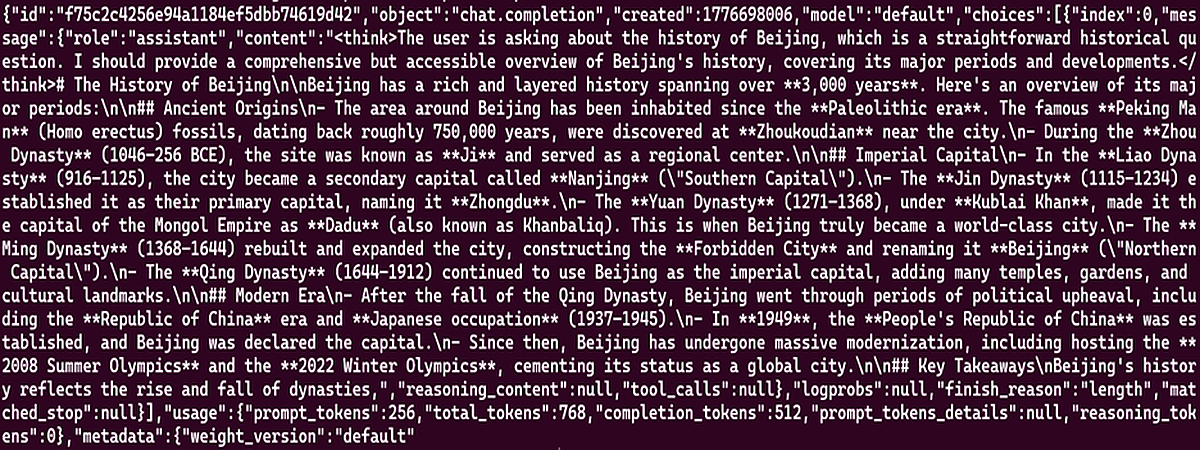
If the serve runs well, you can see the following outputs:
Acknowledgements
AMD team members who contributed to this effort: Andy Luo, Fan Wu, Bill He, Peng Sun, Carlus Huang, Lingpeng Jin, Gilbert Lei, Hattie Wu, Xicheng Feng, and the Xiaomi MiMo team.
Looking Ahead
This blog presents the Day 0 support for Xiaomi’s MiMo-V2.5-Pro model on AMD Instinct GPUs. By following this guide, you have learned how to deploy MiMo-V2.5-Pro using SGLang/ATOM to leverage advanced tool-calling capabilities for agentic workloads, as well as how to run coding and Skills-driven applications locally with this flagship model.
This enablement ensures that your development team can immediately start building robust, agent-centric platforms on the latest AMD hardware. Subsequent posts will dive deeper into kernel-level profiling, custom attention optimizations, and ongoing co-design efforts between the AMD ROCm software stack and MiMo model advancements. Stay tuned.
Get Started
- MiMo Open Platform: platform.xiaomimimo.com
- Join AMD AI Developer Program to access AMD developer cloud credits, expert support, exclusive training, and community.
- Visit the ROCm AI Developer Hub for additional tutorials, open-source projects, blogs, and other resources for AI development on AMD GPUs.
- Explore AMD ROCm Software.
- Learn more about AMD Instinct GPUs.
- Inference Image
- ATOM: aigmkt/mimo-v2.5-pro-atom:latest
- SGLang: aigmkt/mimo-v2.5-pro-sglang:latest

Related Blogs
-
NeuroSpark Expands AI Compute Choice with AMD
NeuroSpark uses AMD Instinct GPUs and ROCm software on OCI to deliver flexible, cost-effective AI training and inference
October 23, 2026
-
Sovereign AI for European Customer Conversations
LeadDesk, QuTwo, and AMD Silo AI collaborate on a sovereign AI stack that brings near-frontier, open-weight models to European customer conversations.
October 22, 2026
-
Scaling 3D Gaussian Splatting with Distributed Compute: Why One GPU Is Never Enough — ROCm Blogs
Learn how to scale 3D Gaussian splatting across GPUs with distributed training, RCCL, and real-world optimization tips for AMD Instinct GPUs
October 22, 2026
-
FP8 GEMM Optimization on AMD RDNA™ 4 Architecture — ROCm Blogs
Learn how to port an FP16 GEMM kernel to FP8 on AMD RDNA 4 and use the smaller element size to unlock larger tiles and deeper K slices.
October 22, 2026
-
Micro-World 2: Streaming Real-time Interactive World Model — ROCm Blogs
This blog demonstrates how Micro-World 2 combines precisely annotated action data, four-step diffusion distillation, and ROCm-optimized inference to deliver controllable, long-horizon, real-time world generation on a single AMD Instinct GPU through a fully open-source pipeline.
October 20, 2026
-
MoE Training Optimization with Primus — ROCm Blogs
Learn how to speed up MoE training on AMD Instinct GPUs with Primus: a fused MoE megakernel, FP8/MXFP8 expert GEMMs, and training-at-scale tuning.
October 20, 2026
-
Optimizing World Action Models on AMD GPUs — ROCm Blogs
Speed up World Action Models on AMD GPUs with GEAK kernels, fewer denoising steps, and latent actions, cutting FastWAM latency 25× at about 97 percent success.
October 20, 2026
-
Bringing Ultra-Fast, Interactive LLM Inference to AMD Instinct™ MI355X GPUs — ROCm Blogs
Accelerate single-request LLM inference on AMD Instinct MI355X with megakernels, speculative decoding, and MXFP4 for 1.9-3.3x faster decode.
October 19, 2026