How AMD PRO Helps IT Manage Enterprise Fleets, From First Boot to Final Wipe
Mar 20, 2026
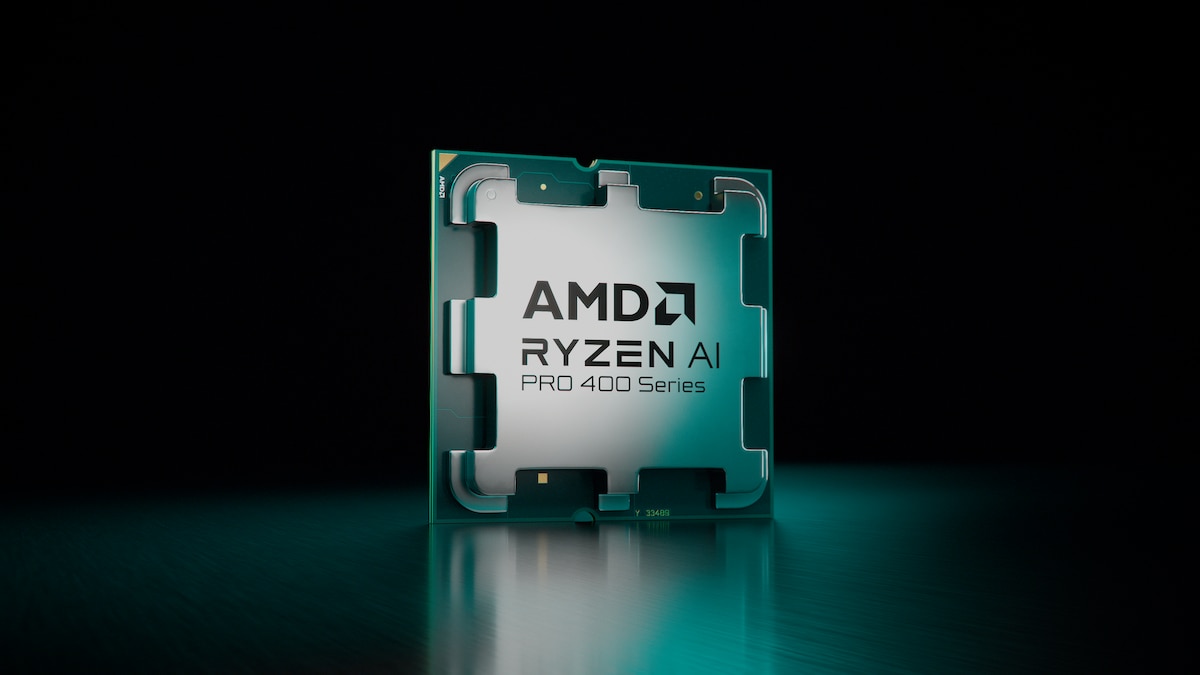
Today, AMD partners including Dell, HP, and Lenovo launched new laptops with AMD Ryzen™ AI PRO 400 Series processors. These professional systems build on the foundations laid by previous generations of AMD PRO PCs, combining leadership performance, robust security, and fleetwide manageability in a single slice of silicon.
For CIOs managing large fleets, the challenge is less a matter of hardware than the complexity of supporting distributed workforces across different devices and OS versions. AMD PRO processors are built to reduce that burden with support for the software IT teams already use, hardware-level security, remote manageability, and compatibility across multiple networking vendors. By extending standards-based out-of-band management over wired and wireless networks, they help IT teams diagnose and remediate systems that OS-level intervention cannot reach. This results in faster recovery from patch or driver failures, fewer desk-side visits, and a cleaner end-of-life process for redeployment or retirement.
Third-party benchmarks show AMD PRO processors handle imaging, patching, and provisioning in timeframes comparable to competing platforms, but there is an important distinction I'd personally like to highlight. Unlike some competitive solutions, AMD PRO manageability supports multiple wireless vendors, giving OEMs and enterprises platform flexibility without sacrificing enterprise grade remote management. For IT teams managing Dell, HP, and Lenovo systems side by side – which describes many large enterprises – AMD PRO delivers consistent out-of-band wireless access.
This is a meaningful point of differentiation with respect to the competition. Where other companies tie manageability support to their own wired and wireless networking hardware, AMD supports solutions from Broadcom, MediaTek, and Qualcomm. To achieve this adaptability, AMD builds its remote management stack on the DASH (Desktop and Mobile Architecture for System Hardware) open standard, then adds custom capabilities in the AIM-T (AMD Integrated Management Technologies) layer. All AMD platforms launching in 2026 add support for five remote management features: Remote Windows Recovery, Remote Disk Erasure, Active Directory authentication, high-resolution KVM support, and a new web UI interface.
The decision to adopt DASH rather than developing a proprietary software stack has long-term implications for manageability and support. Standards that only function with one specific set of components can lock companies into vendor-specific dependencies that only become more difficult to break as time goes by. In some cases, companies wind up implementing features based on the idiosyncratic behavior of the software they are required to use as opposed to adopting industry best practices. An open standard means fleets equipped with AMD PRO processors have access to a broader ecosystem of management software vendors, with more options for wired and wireless networking.
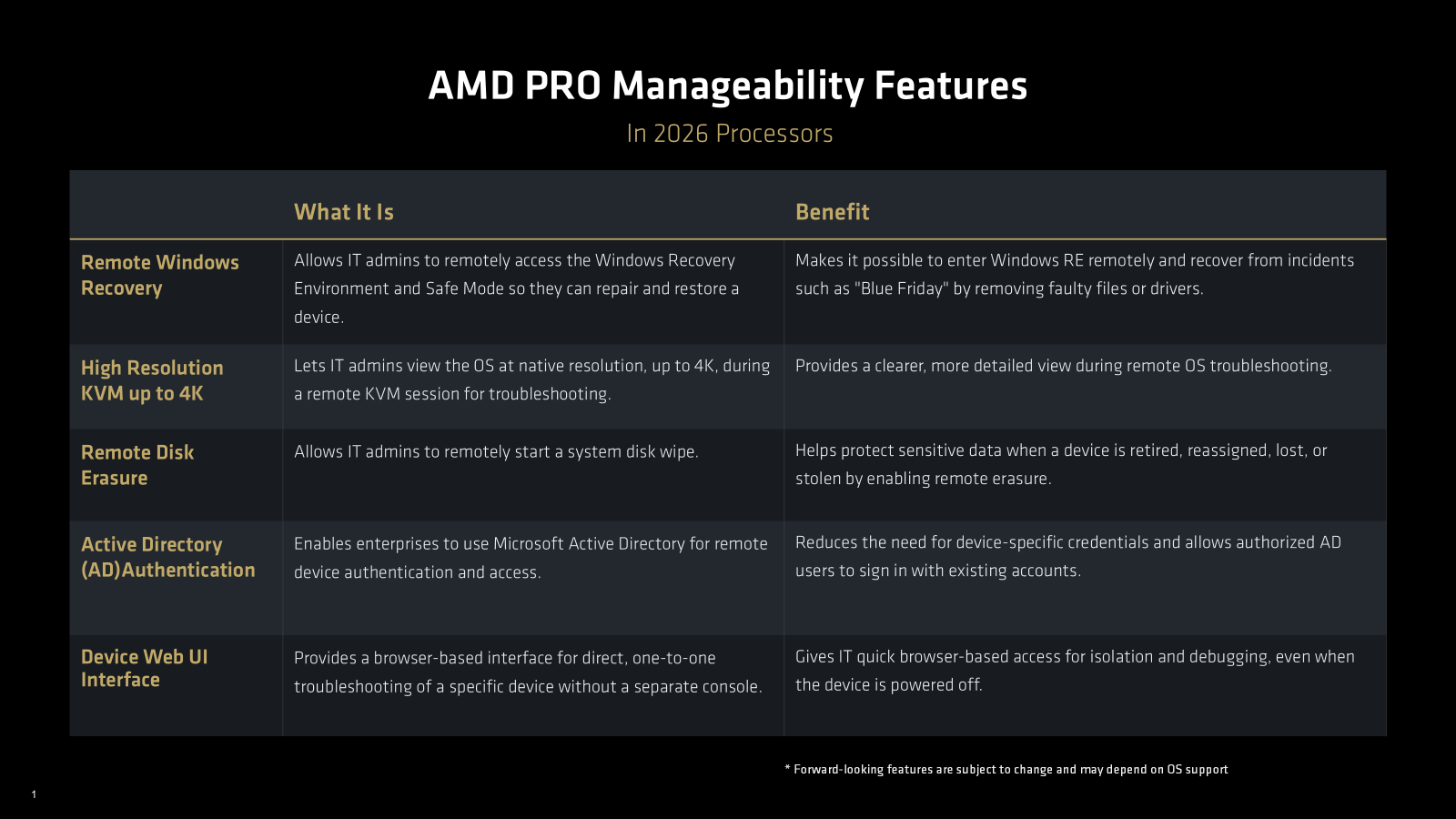
Remote Windows Recovery gives administrators access to the Windows Recovery Environment, where they can restore or re-image systems, diagnose and repair boot failures, change startup settings, remove bad drivers or software, and open a command prompt among other capabilities. In practice, Windows RE can bring back machines that would otherwise require hands-on service, reducing the need to ship far-flung systems home or to send IT staff on desk-side visits to every local PC.
Remote Disk Erasure can securely erase a device as part of system decommissioning, redeployment, or as a defensive measure if a machine is reported lost or stolen. Microsoft Active Directory authentication provides help desks with the option to log into systems without requiring device-specific credentials. Instead, authorized AD users can use their own logins and passwords for connection.
The browser-based management interface may seem less glamorous than these other features, but it addresses a genuine concern. Historically, out-of-band (OOB) management has suffered from an activation problem. Many companies purchase these capabilities but never fully enable them fleetwide because configuration is complex and the payoff is uncertain until it's suddenly, desperately needed. A browser-accessible interface lowers that barrier and makes deployment more likely before a crisis sends IT staff searching for solutions.
Managing the Day-to-Day
The ability to recover a previously dead system via out-of-band management is an important capability, but many companies don’t need these services on a literal daily basis. AMD PRO processors are also built for the more mundane aspects of IT support, like keeping large device fleets consistent, recoverable, and secure over years of daily use.
In practice, IT needs to bring systems online without touching each one, manage policies, patches, drivers, and software across mixed fleets, spot performance or UX issues before they become support tickets, and recover or retire devices when they fail, disappear, or reach end of life. Steady operational control matters, particularly in large organizations serving hundreds or thousands of employees with different compute needs.
The IT department might like nothing better than to standardize the entire company on a handful of SKUs from just one vendor but real-world deployments are rarely so neat in the long term. Most businesses buy from multiple OEMs, support workers on different networks, and run a wide range of applications with different performance characteristics.
AMD PRO processors are built for this rather messy reality and give IT a consistent foundation across multi-vendor deployments irrespective of whose logo is on the lid. They are compatible with a wide range of third-party tools and services, including Microsoft Intune & SCCM (System Center Configuration Manager), Splunk, Nexthink, ServiceNow, Infoblox, and Lakeside. These tools address different aspects of systems management, from troubleshooting and repair to aggregate log monitoring, incident reports, and DNS / DHCP management. Collectively, they help IT keep systems running well, regardless of form factor, OEM vendor, or geographic location.
AI PCs That Support Your Business—and Your IT Team
Manageability is essential, but it is not the only enterprise requirement. AI PC shipments are growing rapidly as OS developers and ISVs build more local and hybrid AI experiences, and enterprises are keenly interested in what AI has to offer.
All AMD Ryzen AI PRO processors integrate an NPU so systems can run local AI models without putting undue strain on battery life or requiring a constant internet connection. When new models or applications arrive, administrators can push updated models at scale across AMD fleets using standard management consoles. Many software issues can be identified and addressed with the same tools IT already uses.
Enterprise PCs and workstations usually stay in service for years, and AMD PRO manageability supports every stage of their life cycle, from zero-touch onboarding and remote troubleshooting to data sanitization at retirement. Because manageability is built into every AMD Ryzen AI PRO 400 Series processor, IT planners can set policy once and apply it across price tiers, form factors, and vendors. AMD also provides software support for five years after a processor’s final ship date, helping keep the management stack functional and updated until device retirement.
That consistency extends across price tiers, form factors, vendors, and the management tools IT teams already rely on. It’s part of why AMD PRO processors have moved from an alternative option to the solution a growing number of enterprise IT teams ask for by name. If your next refresh needs dependable management from first boot to final wipe, the AMD Ryzen AI PRO 400 Series and our OEM partners are ready.

Related Blogs
-
Kimi K3 on AMD Instinct GPUs with TokenSpeed
TokenSpeed delivers fast, agentic LLM inference on AMD Instinct™ MI355X GPUs, with optimized kernels and leading Kimi K3 performance.
October 09, 2026
-
scikit workloads with AOCL Data Analytics
Accelerate supported scikit-learn workloads with AOCL-Data Analytics while keeping your existing Python code and familiar scikit-learn APIs.
October 09, 2026
-
MangoBoost Delivers Open AI Models Powered by AMD
Mango Inference a serverless inference service providing production-ready access to open models powered by AMD Instinct™ GPUs and AMD ROCm™ software
October 09, 2026
-
Pre-Training Hybrid LLMs from Scratch in Primus on AMD Instinct™ GPUs — ROCm Blogs
Pre-train hybrid LLMs mixing MLA attention with Gated DeltaNet, Kimi Delta Attention and Mamba2 mixers on AMD Instinct MI355X GPUs, with open recipes.
October 07, 2026
-
DI Series: Serving Kimi-K3 MXFP4 Wide-EP Disaggregated on AMD Instinct MI300X and MI325X — ROCm Blogs
Learn how to serve a 1.4 TiB Kimi-K3 MXFP4 mixture-of-experts model disaggregated across AMD Instinct MI300X and MI325X GPUs.
October 07, 2026
-
AMD Instinct MI455X vs MI355X: A Technical Look at the Advancing AI 2026 Inference Numbers — ROCm Blogs
Explore the MI455X vs MI355X inference numbers from Advancing AI 2026, and learn how each benchmark was measured and what it really means.
October 07, 2026
-
Completing the GPU Performance Picture: Understanding TAF Alongside Peak FLOPs and MAF — ROCm Blogs
Learn how Typical Attained FLOPs complements Peak FLOPs and Max-Achievable FLOPs, including the methodology and MI325X results
October 05, 2026
-
How Agentic AI Is Expanding the Role of the DPU
As agentic AI drives more stateful workloads, DPUs are becoming critical for networking, storage, KV-cache management, and infrastructure efficiency.
October 05, 2026