Our Approach

Corporate responsibility is integral to how we operate as a global business, valued partner and trusted employer. From advancing high-performance and energy-efficient computing to cultivating an innovative, inclusive workforce, we are committed to driving the computing industry forward responsibly.

Focus Areas

We prioritize corporate responsibility across our value chain by focusing on key topics that have the greatest impact on our business and society. We advance this work through four strategic focus areas.

Our Goals and Progress

We have set public goals and are committed to making meaningful progress in our corporate responsibility efforts.

Digital Impact


104.8M
People benefited from AMD and AMD Foundation philanthropy and partnerships that enable STEM education, scientific research and the workforce of the future (2020-25)¹

Target: 100 million

Diversity, Belonging and Inclusion


67%
Employees participated in AMD employee resource groups and/or other inclusion initiatives (2020-25)²

Target: 70%

Environmental Sustainability


30%
Scope 1 and 2 GHG emissions reduction (2020-30)³

Target: 50%

38x
Energy efficiency improvement for AI training and HPC (2020-25)⁴,⁵

Target: 30x

4x
Estimated increase in rack-level energy efficiency for AI training and inference in 2026 (2024-30)⁶,⁷

Target: 20x

100%
Manufacturing Suppliers⁸ with public GHG reduction goals (2020-25)⁹

Target: 100%

82%
Manufacturing Suppliers sourcing renewable energy (2020-25)¹⁰

Target: 80%

8%
Supply chain carbon intensity reduction (2024-30)¹¹,¹²

Target: 25%

Supply Chain Responsibility


99%
Manufacturing Suppliers had an RBA audit or equivalent (2020-25)⁹

Target: 100%

88%
Manufacturing Suppliers by spend participated in a capacity-building activity (2020-25)¹³

Target: 80%

Our Reporting

Guided by a commitment to transparency, we report our performance and progress toward our goals in our annual Corporate Responsibility Report.

Five volunteers in blue AMD T-shirts stand outdoors holding shovels and a rake, ready for a community cleanup event.

Strengthening AMD Communities Worldwide

We are passionate about giving back to the communities where we live and work. For more than 45 years, AMD has invested in organizations around the globe that make a meaningful difference today and help create a better tomorrow.

Advancing with Purpose

Meet the people behind AMD corporate responsibility efforts through a video series featuring the voices and stories shaping our work.

Our Latest Efforts

External Recognition

We are honored to receive the following awards and recognition:14

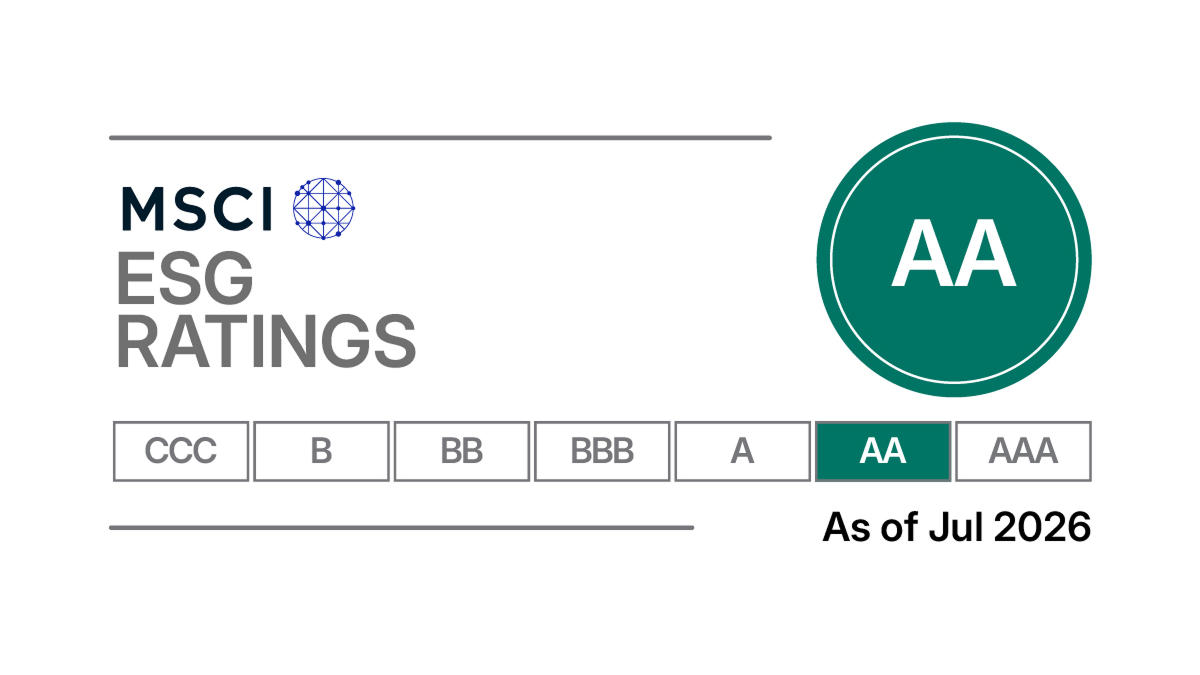
MSCI ESG Ratings graphic showing an AA rating, highlighted on the rating scale from CCC to AAA, with text "As of Jul 2026."
Human Rights Award
ecovadis sustainability rating 2025
America's Most Just Companies 2025
100 Best Corporate Citizens 2025 Logo
Climate CDP 2025 Logo
Gray and orange graphic with text “Supplier Engagement Leader,” CDP logo, and “2025” award branding.
Footnotes
  1. The time period for the Digital Impact goal includes donations made after Jan. 1, 2020, and initiated by Dec. 31, 2025. “Initiated” is defined as AMD and the recipient organization reaching an agreement on an AMD donation, which must be delivered by July 30, 2026. Reported data include direct beneficiaries defined as students, faculty or researchers with direct access to AMD-donated technology, funding or volunteers; and indirect beneficiaries defined as individuals with a reasonable likelihood of receiving research data formulated through AMD-donated technology and potentially gaining useful insights or knowledge or being impacted by the application of the research. AMD conducts annual surveys with recipient organizations to estimate direct beneficiaries and, in the case of the AI & HPC Fund, indirect beneficiaries as well. Based on three years of responses (2021-23), AMD created an economic-based impact assumption to estimate the total number of indirect beneficiaries (not applied to direct beneficiaries) by dividing the total market value of donations in a given year by the total reported indirect beneficiary values from recipients’ surveys for the same year. The data shows the ratio is 1.08 on average for the three years of data used in the model. Therefore, AMD assumes for every US$1 million of market value donated, approximately 1.08 million people will indirectly benefit. AMD also assumes that the annual estimated indirect beneficiaries in year 1 continue to reach additional individuals in year 2 and year 3, but at a reduced rate. The impact depreciation rate assumes year 2 beneficiaries amount to 50% of year 1 estimates and year 3 beneficiaries amount to 25% of year 1 estimates. AMD goal calculations are third-party verified (limited-level assurance) based on data supplied by recipient organizations, which is not independently verified by AMD, and AMD economic-based impact models based on data supplied by recipient organizations. The model mentioned above was extended to data from the AMD University Program (which now includes the AI & HPC Fund) for 2023-24.
  2. These are voluntary initiatives in which an employee chooses to actively participate in one or more employee engagement programs that foster a culture of belonging, psychological safety and meaningful connection to AMD. Goal calculations are based on internal analysis of ERG membership, employee volunteers and charitable donors each year during the goal period.
  3. Reported data includes Scope 1 and 2 GHG emissions (base year 2020) and is based on AMD calculations that are third-party verified (limited level assurance).
  4. Includes AMD high-performance CPU and GPU accelerators used for AI-training and high-performance computing in a 4-Accelerator, CPU-hosted configuration. Goal calculations are based on performance scores as measured by standard performance metrics (HPC: Linpack DGEMM kernel FLOPS with 4k matrix size; AI-training: lower precision training-focused floating-point math GEMM kernels such as FP16 or BF16 FLOPS operating on 4k matrices) divided by the rated power consumption of a representative accelerated compute node, including the CPU host + memory and 4 GPU accelerators.
  5. EPYC-030c: Calculation includes 1) base case kWh use projections in 2025 conducted with Koomey Analytics based on available research and data that includes segment specific projected 2025 deployment volumes and data center power utilization effectiveness (PUE) including GPU HPC and machine learning (ML) installations and 2) AMD CPU and GPU node power consumptions incorporating segment-specific utilization (active vs. idle) percentages and multiplied by PUE to determine actual total energy use for calculation of the performance per watt. The 38x improvement is calculated using the following formula: (base case HPC node kWh use projection in 2025 * AMD 2025 performance per watt improvement using DGEMM and TEC + base case ML node kWh use projection in 2025 *AMD 2025 performance per watt improvement using ML math and TEC) / (base case projected kWh usage in 2025). For more information, visit www.amd.com/en/corporate/corporate-responsibility/data-center-sustainability.html.
  6. The AMD 20x30 energy efficiency goal is based on representative AMD rack configurations that incorporate projected improvements across compute, memory and networking performance as well as power consumption. Additional methodology, assumptions and technical details are available on the AMD Data Center Sustainability webpage.
  7. Progress toward the AMD 20x30 goal is measured by comparing annual AMD rack configurations against a 2024 baseline using a performance-per-watt methodology. The 2026 result reflects a combination of measured product data and modeled estimates where final performance data was not available. Additional assumptions, calculations and progress-to-goal details are available on the AMD Data Center Sustainability webpage. 
  8. “Manufacturing Suppliers” are defined as suppliers that AMD buys from directly and that provide direct materials and/or manufacturing services to AMD.
  9. AMD calculations received external limited-level assurance and are based on data supplied by our Manufacturing Suppliers. AMD does not independently verify the supplier-provided data.
  10. AMD defines renewable energy as energy from a source that is not depleted when used, such as wind or solar power. AMD does not require a minimum amount of renewable energy to be sourced by Manufacturing Suppliers to be included in the goal. Data is provided by AMD suppliers and has not been independently verified by AMD.
  11. The AMD supply chain carbon emissions intensity metric is based on Manufacturing Supplier emissions (mtCO2e) divided by AMD net revenue (US$ million). Final performance on the goal will be calculated by subtracting the target year (2030) carbon intensity from the base year (2024) carbon intensity and dividing the difference by the base year (2024). For the base year and the target year, AMD will use Manufacturing Suppliers’ emissions from the corresponding reporting year. For the interim goal years (2025-29), AMD will estimate reporting year emissions for each of these suppliers by taking the previous year emissions (mtCO2e across Scope 1, Scope 2 and Scope 3 Category 1) and dividing by the previous year AMD spend (US$ million) with each individual supplier, then multiplying by the current year AMD spend (US$ million) with each supplier. AMD is taking this approach to balance efforts to promote both accuracy - including the time needed for Manufacturing Suppliers to complete reviews, auditing, and reporting within AMD channels - and transparency, by providing what AMD has determined is a reasonable estimate of these supplier emissions in the reporting year.
  12. Estimated performance on the AMD carbon emissions intensity goal from 2024 to 2025 is a reduction of approximately 8%. The 2024 carbon emissions intensity is 98.3 (2,533,494 mtCO2e /US$25,785 million AMD net revenue). The 2025 estimated carbon emissions intensity is 90 (3,115,021 mtCO2e / US$34,639 million AMD net revenue). This figure and associated estimated goal performance may change when verified 2025 data is received from AMD Manufacturing Suppliers.
  13. Capacity-building activities aim to promote continuous improvement among AMD Manufacturing Suppliers by providing resources that help suppliers better understand the root causes of noncompliance or pursue goals beyond compliance.  Goal performance calculations received external limited-level assurance.
  14. The use by AMD of any MSCI Solutions LLC and related entities (“MSCI”) data, and the use of MSCI logos, trademarks, service marks or product names, do not constitute a sponsorship, endorsement, recommendation, or promotion of AMD by MSCI. The Ratings are solely the opinion of MSCI Solutions and do not constitute an offer, promotion, or recommendation of any security or trading strategy, and may not be used to determine which securities to buy or sell or when, nor is it an indication or guarantee of future performance. MSCI services and data are the property of MSCI or its information providers, are provided ‘as-is’ and without warranty, and MSCI disclaims all liability, including for any damages. All uses of any Rating are also subject to the disclaimer and: https://www.msci.com/legal/notice-and-disclaimer and disclosures at: https://www.msci.com/legal/sustainability-and-climate-resources-and-disclosures, each of which may be updated by MSCI from time to time.