
Agents Are the Future of AI Work
Generative AI has, until recently, largely followed “token in, token out” workflows; your customer asks AI a question or for information, and it responds. It’s a simple call-and-response that’s now evolving into something more powerful: agentic AI.
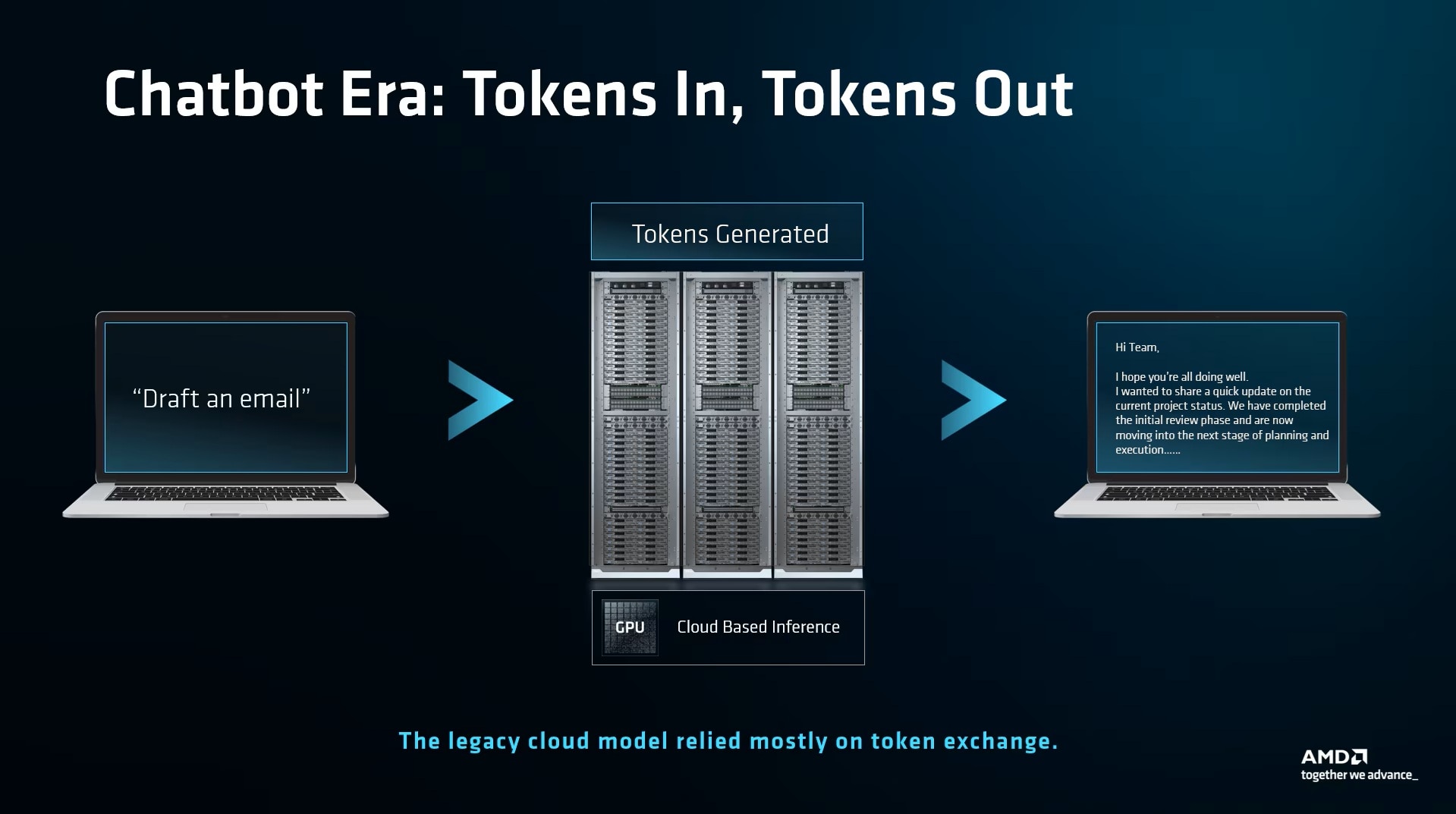
Agentic AI delivers a wealth of new possibilities for customers, from interacting with files and applications, executing code and commands, calling tools and completing multistep workflows. It’s even possible to coordinate multiple agents at once to deliver powerful results across a variety of tasks.
While AMD EPYC™ server CPUs and the AMD Helios™ rackscale platform are helping define the next generation of data center AI infrastructure, AMD “Zen 5” architecture also matters at the client edge, bringing AI-ready performance, efficiency and responsiveness to the PCs and workstations where employees actually interact with AI-enabled tools.
Agentic AI Demands CPU Performance
Many of the actions associated with agentic AI can take place on the local device. The model decides what needs doing, the agent calls a tool, the CPU helps execute the action, the result is returned to the model, and this continues until the task is complete.
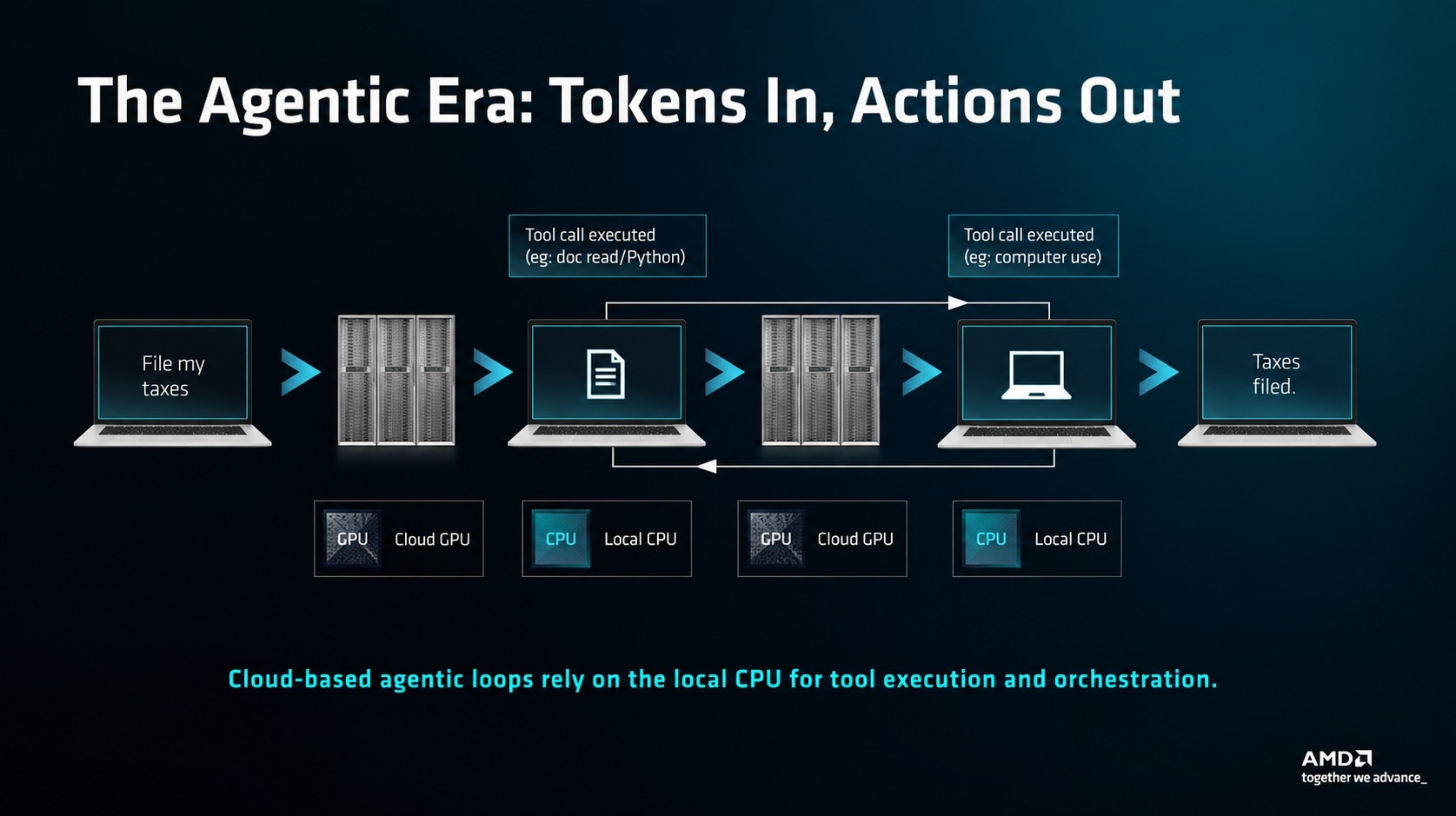
Asks of the CPU can include many types of requests:
- Opening and/or parsing files
- Performing calculations
- Executing Python/code
- Compiling code
- Searching directories
- Launching programs and/or processes
- Controlling applications
- Coordinating workers
While inference may happen in the cloud or on a local GPU or NPU, the CPU handles much of the broader execution and scheduling required by the workflow.
A New Measure for Agentic PC Performance
What ultimately matters is how quickly the agent completes the task. As agents perform more operations, CPU performance affects the factors your customers care about, from application performance and local processing to total task completion time.
The CPU in customer devices can therefore have a direct impact on how well these agentic workloads perform. With many agentic workloads performing dozens of operations or running multiple subagents, customers looking to lean into agentic AI need CPU performance they can consistently rely on. This is where strong CPU performance becomes increasingly important, and where AMD Ryzen™ processors based on “Zen 5” architecture are designed to deliver the performance these workloads require.
Built for Agentic AI
AMD Ryzen™ Processors Based on “Zen 5” Architecture
AMD processors built on “Zen 5” architecture are designed to deliver the CPU performance increasingly demanding workloads require. Across the AMD Ryzen processor portfolio, that includes configurations scaling up to 16 cores and 32 threads with the AMD Ryzen™ AI Max+ 395 processor. So, what does that difference in CPU performance look like in practice?
AMD tested a demanding developer workflow running six agents concurrently. Across the workload, agents carried out a wide range of local tasks, including code analysis and compilation, data processing, database queries, compression and package operations.
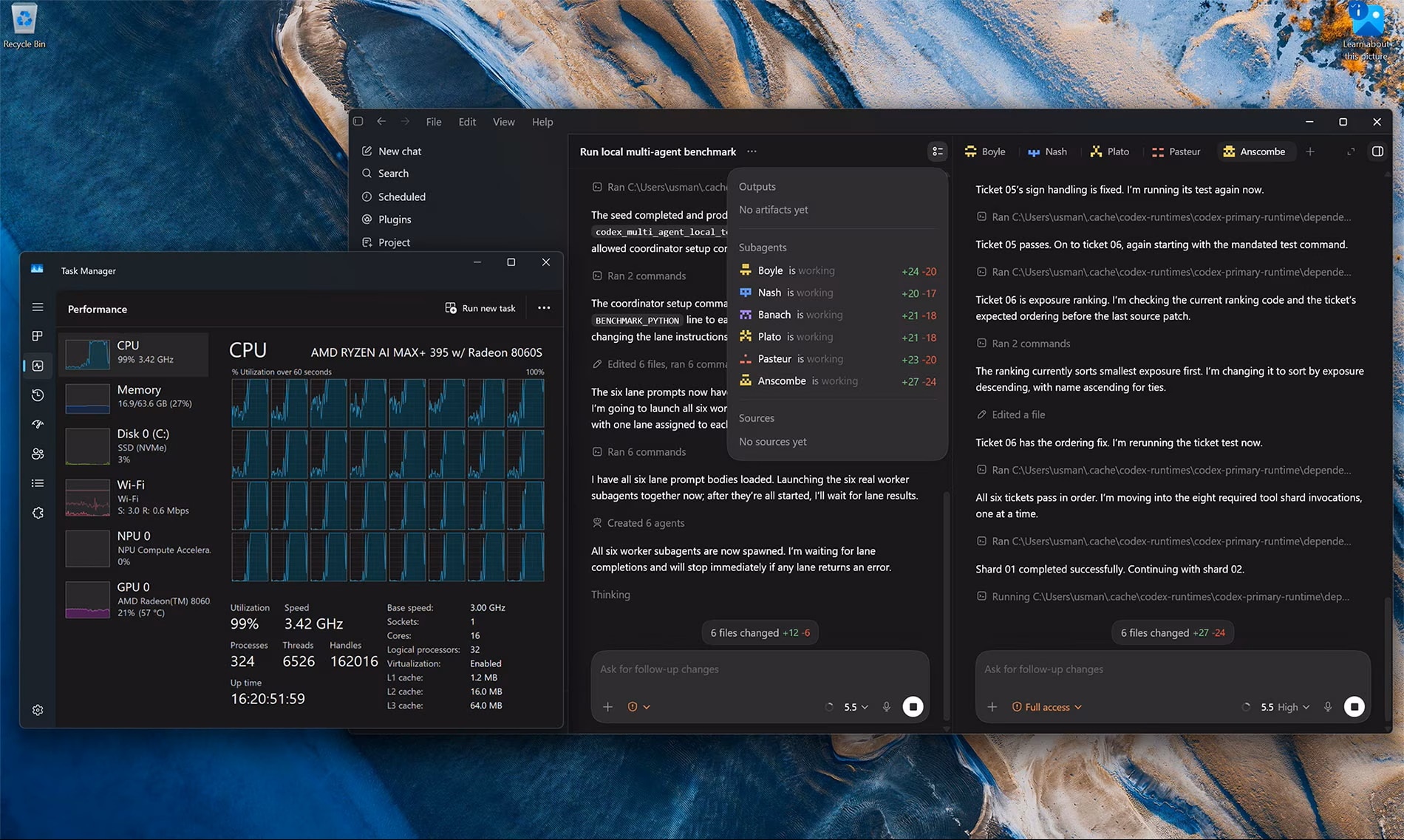
The results make the value of a modern AMD Ryzen processor clear; in AMD testing of a multiagent, tool-heavy developer workflow, an ASUS ROG Flow Z13 with an AMD Ryzen AI Max+ 395 processor delivered up to 6x faster task completion than a four-year-old laptop.1,2
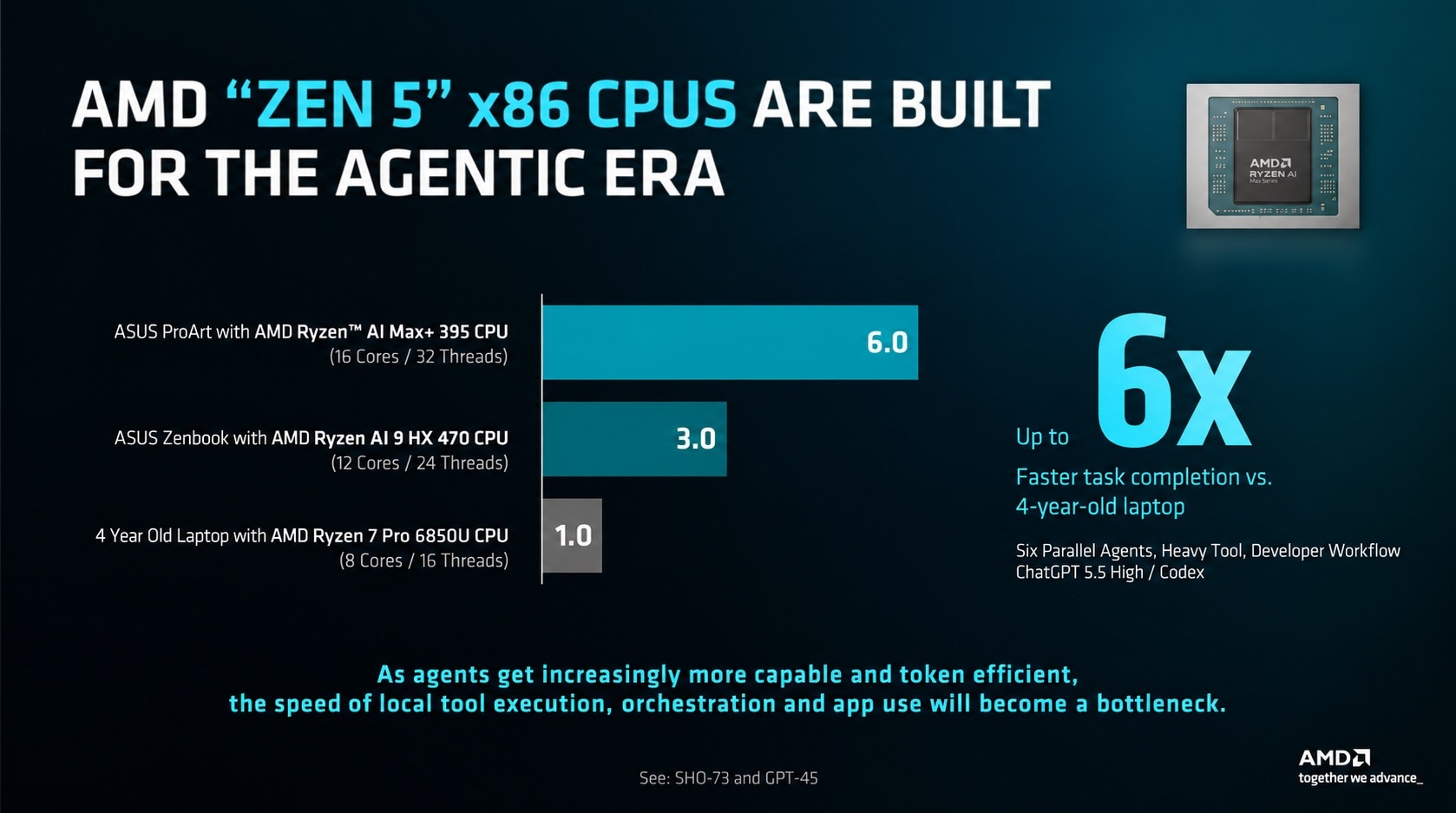
For customers, such performance becomes increasingly valuable as their use of AI grows. An agent might begin with a simple request, then move through dozens of individual actions before completing the job. Add more agents working alongside it, and the amount of local processing compounds quickly.
AMD Ryzen processors built on “Zen 5” architecture give customers the high-performance CPU foundation to keep up with those workloads, helping agents turn their decisions into action quickly across local files, applications, tools and data.
As businesses plan for the next generation of AI, the conversation goes beyond how quickly their systems can run an AI model. They also need the local performance to keep pace with everything that AI is now capable of doing.
With AMD Ryzen processors based on “Zen 5” architecture, you can help customers prepare their devices for that shift and make sure their investment in AI infrastructure has the local CPU performance needed to turn intelligence into useful work.
Prepare Customers for Agentic AI
AI agents are changing the role of the PC. As AI moves deeper into everyday workflows, client devices will increasingly participate in the work required to turn model outputs into completed tasks. For AMD partners, the rise of agentic AI is an opportunity to approach customers and help them plan for this new era of AI computing.
AMD Ryzen processors built on “Zen 5” architecture provide a high-performance CPU foundation for demanding agentic AI workloads. Help customers prepare their device fleets for an agentic way of working with AMD.
AMD Arena
Build expertise with training on AMD AI solutions, AMD EPYC™ server CPUs, AMD Instinct™ GPUs and more across the AMD portfolio.
Subscribe
Get monthly updates on the latest AMD products, training resources and Meet the Experts webinars.

Related Articles
-
AMD Ryzen™ 7000 Series Desktop Processors
With its unique features & integrated graphics, the AMD Ryzen™ 7000 Series Desktop gaming processor provides performance for gamers & creators. Learn …
-
Meet the AMD Socket AM5 Platform
The AM5 Socket platform with AMD Ryzen 7000 Series processors supports features like PCIe® 5.0 & Wi-Fi 6E & more. Learn more about PC gaming with AMD.
-
A Leap Ahead in Power and Efficiency
AMD Ryzen™ 6000 Series mobile processors deliver leadership in computing efficiency, with the updated “Zen 3+” CPU core and AMD RDNA™ 2 game-ready gra…
-
From 4nm to AI: AMD Ryzen™ Processors
Explore AMD in PC technology: from 4nm to AI. Discover how AMD Ryzen™ processors lead in AI integration, battery life, & power in the modern computing…
-
AMD Ryzen™ 8000 G-Series Processors
AMD Ryzen™ 8000 G-Series processors are an all-in-one solution, offering cutting-edge processing, graphics, and a dedicated AI Engine, or ‘NPU’, for i…
-
AMD Ryzen™ AI 300 Series Processors
A new era of AI computing is upon us. Use the power of AMD Ryzen™ AI 300 Series processors to enjoy everything AI-enhanced today and in the future.
-
AMD Ryzen™ 9000 Series Processors
Don’t settle for anything less than perfection when it comes to desktop performance. With AMD Ryzen™ 9000 Series Processors, you won’t have to.

Related Training Courses
Related Webinars
Footnotes
- Testing as of July 2026 by AMD. Performance measured as average local tool shard execution time over multiple runs of a CODEX, Python-based, multi-agent, heavy tool usage workflow. The workflow used six parallel Codex subagents with ChatGPT 5.5 High and a Python harness to perform deterministic offline developer-tool work, including AST/static analysis, compile/import smoke tests, unit-style execution, JSON/CSV serialization, SQLite queries, compression/hashing, package/manifest work, and mixed local-tool workloads. System specifications: ASUS ROG Flow Z13 with AMD Ryzen™ AI Max+ 395 processor, 128GB memory, AMD Variable Graphics Memory set to 64GB, AMD Software: Adrenalin Edition 26.6.2, Performance mode, Windows 11 Pro 25H2, compared with an HP EliteBook with AMD Ryzen™ PRO 6850U processor, 32GB memory at 4800 MT/s, AMD Software: Adrenalin Edition™ software 24.10.20.01, Performance mode, Windows 11 Pro 25H2. All values up to. Performance may vary. SHO-73.
- Testing as of July 2026 by AMD. Performance measured as average local tool shard execution time over multiple runs of a CODEX, Python-based, multi-agent, heavy tool usage workflow. The workflow used six parallel Codex subagents with ChatGPT 5.5 High and a Python harness to perform deterministic offline developer-tool work, including AST/static analysis, compile/import smoke tests, unit-style execution, JSON/CSV serialization, SQLite queries, compression/hashing, package/manifest work, and mixed local-tool workloads. System specifications: ASUS Zenbook S16 with AMD Ryzen™ AI HX 470 processor, 32GB memory at 8533 MT/s, AMD Software: Adrenalin Edition 26.6.2, Performance mode, Windows 11 Pro 25H2, compared with an HP EliteBook with AMD Ryzen™ PRO 6850U processor, 32GB memory at 4800 MT/s, AMD Software: Adrenalin Edition 24.10.20.01, Performance mode, Windows 11 Pro 25H2. All values up to. Performance may vary. GPT-45.
- Testing as of July 2026 by AMD. Performance measured as average local tool shard execution time over multiple runs of a CODEX, Python-based, multi-agent, heavy tool usage workflow. The workflow used six parallel Codex subagents with ChatGPT 5.5 High and a Python harness to perform deterministic offline developer-tool work, including AST/static analysis, compile/import smoke tests, unit-style execution, JSON/CSV serialization, SQLite queries, compression/hashing, package/manifest work, and mixed local-tool workloads. System specifications: ASUS ROG Flow Z13 with AMD Ryzen™ AI Max+ 395 processor, 128GB memory, AMD Variable Graphics Memory set to 64GB, AMD Software: Adrenalin Edition 26.6.2, Performance mode, Windows 11 Pro 25H2, compared with an HP EliteBook with AMD Ryzen™ PRO 6850U processor, 32GB memory at 4800 MT/s, AMD Software: Adrenalin Edition™ software 24.10.20.01, Performance mode, Windows 11 Pro 25H2. All values up to. Performance may vary. SHO-73.
- Testing as of July 2026 by AMD. Performance measured as average local tool shard execution time over multiple runs of a CODEX, Python-based, multi-agent, heavy tool usage workflow. The workflow used six parallel Codex subagents with ChatGPT 5.5 High and a Python harness to perform deterministic offline developer-tool work, including AST/static analysis, compile/import smoke tests, unit-style execution, JSON/CSV serialization, SQLite queries, compression/hashing, package/manifest work, and mixed local-tool workloads. System specifications: ASUS Zenbook S16 with AMD Ryzen™ AI HX 470 processor, 32GB memory at 8533 MT/s, AMD Software: Adrenalin Edition 26.6.2, Performance mode, Windows 11 Pro 25H2, compared with an HP EliteBook with AMD Ryzen™ PRO 6850U processor, 32GB memory at 4800 MT/s, AMD Software: Adrenalin Edition 24.10.20.01, Performance mode, Windows 11 Pro 25H2. All values up to. Performance may vary. GPT-45.