A progressive approach to accelerating system-level verification for AMD Versal™ adaptive SoC designs
Apr 17, 2026

AMD Versal™ adaptive SoCs provide developers a heterogeneous computing architecture that combines programmable logic (PL), AI Engines, and high-performance processing systems within a single device. These compute elements are interconnected through a programmable network on chip (NoC) and are used together to implement complex, high-performance systems.
While this architectural flexibility enables significant gains in performance and efficiency, it also introduces additional verification complexity. A Versal device design spans multiple domains, including AI Engine graphs, and HLS or RTL-based PL design, along with software running on the processing system. Each domain is developed using different tools and abstractions, often by different teams.
Verifying these components function correctly as an integrated system is one of the most demanding aspects of Versal device development. System-level verification must ensure algorithmic correctness, correct integration between subsystems, and correct behavior once deployed to hardware. Historically, this level of verification has relied on hardware emulation,
which, while accurate, introduces complexity and performance limitations that restrict its usefulness earlier in the design cycle.
The AMD Vitis™ Unified Software Platform introduces an alternative range of simulation flows that overcome these limitations. Functional simulation, XSIM-based subsystem simulation, and hardware-in-the-loop verification enable a progressive approach to verification that begins earlier, executes faster, and reduces overall project risk. These flows complement one another and can be applied effectively to Versal adaptive SoC system development.
Hardware Emulation as the Traditional Baseline
Prior to the availability of newer system simulation flows, the primary verification approach for Versal device designs was hardware emulation within Vitis software. This flow combines several independent simulators to model the major subsystems of a Versal device.
In a typical hardware emulation verification, the processing system is simulated using QEMU, the PL is simulated using XSIM with an HDL testbench, and the AI Engine array is simulated using the System-C based AI Engine (AIE) simulator. Together, these simulators provide functional accuracy across the full system and support execution of software applications interacting with the PL and AI Engines.
While this approach produces valid and informative results, it is complex. Each simulator operates at a much lower speed than real silicon and often at different time resolutions. As a result, significant effort is required to configure and maintain synchronization between simulators.
To preserve correct system behavior, clocks, events, memory transactions, and interrupts
must be continuously coordinated across QEMU, XSIM, and the AIE simulator. This cross-simulator synchronization introduces communication overhead and frequent context switching, which significantly reduces overall simulation throughput. Additional factors such as debug visibility and transaction-level modelling further contribute to slow execution.
As Versal adaptive SoC designs scale in complexity, with deeper pipelines, wider datapaths, and more sophisticated interconnects, the limitations of hardware emulation become increasingly pronounced. While hardware emulation remains valuable for certain use cases, it is not always well suited for rapid iteration or early-stage system validation.
A Progressive System Simulation Strategy
Rather than relying exclusively on hardware emulation, Versal device development benefits from a progressive system simulation strategy that applies different verification techniques at different stages of the design process.
This strategy consists of three complementary flows:
- Functional simulation focuses on algorithmic correctness at a high level
- XSIM-based subsystem simulation validates integration between AI Engines and the PL
- Hardware-in-the-loop verification executes the design on a real Versal device under software control
Each flow addresses specific verification goals and avoids the overhead associated with full hardware emulation when it is not required. Together, they provide a structured path from algorithm.
Flow 1: Functional Simulation for Versal Adaptive SoC Systems
Functional simulation focuses on verifying what a design does rather than how it behaves at the cycle level. For Versal devices, this typically involves validating AI Engine graphs and HLS-generated kernels before they are integrated into a larger system.
Vitis Functional Simulation enables developers to simulate AI Engine and HLS designs using Python, MATLAB, or C++ (early access). This allows verification to be performed in the same environments commonly used for algorithm development, reducing friction between software modelling and hardware implementation.
Because functional simulation operates at a higher level of abstraction, simulation performance is significantly higher than hardware emulation. This makes it practical to process large datasets, explore architectural parameters, and evaluate numerical performance metrics early in the design flow.
To enable seamless interaction between software frameworks and Versal device designs, functional simulation uses a unified array type that supports fixed-point and floating-point data formats commonly used by AI Engines and HLS kernels. This allows data to be exchanged without manual conversion or loss of fidelity.
Functional simulation is particularly effective for early validation, where rapid iteration and algorithmic insight are more important than cycle accuracy.
Transitioning from Algorithms to Subsystems
Once functional correctness has been established, the next challenge is to verify that AI Engine designs integrate correctly with the PL and system-level infrastructure. At this stage, functional simulation alone is no longer sufficient, as it does not capture data movement, interface behavior, or subsystem interactions.
This transition marks the point where subsystem-level simulation becomes essential.
Flow 2: XSIM-based Subsystem Simulation
XSIM-based simulation enables Vitis subsystems to be simulated directly within the AMD Vivado™ Design Suite environment. In this flow, the design defined in Vitis containing a combination of AI Engine, HLS, and PL kernels is packaged as a Vitis subsystem and
imported into a Vivado Design Suite project, where it is integrated with surrounding PL.
The Vitis subsystem is exercised using the AI Engine testbench replacing the processing system. The testbench in this case should be SystemVerilog, which eliminates the need for QEMU. This significantly reduces simulation overhead compared to hardware emulation. This approach allows PL designers to verify not only the AI Engine functionality but also data movement, interface correctness, and integration behavior with custom RTL models while retaining visibility into both RTL and AI Engine activity.
Because this flow avoids full processor simulation and associated overhead, it executes significantly faster than hardware emulation while still providing meaningful system context. It represents an important intermediate step between functional simulation and hardware execution. Crucially, XSIM-based verification is cycle accurate (AI Engine simulation is cycle approximate) and enables developers to verify not only performance and interfacing but alsothroughput and latency.
Analysis and Visibility With Vitis Tools
During XSIM-based simulation, AI Engine execution can be analyzed using Vitis Analyzer. This provides insight into graph structure, tile utilization, and execution behavior, complementing the RTL-level visibility provided by Vivado tools.
By correlating subsystem behavior observed in XSIM with AI Engine execution data, developers can identify performance bottlenecks and integration issues before committing to hardware implementation.
At this stage, teams can be confident that the algorithm is correct and that the AI Engine and PL subsystems function together as intended.
Flow 3: Hardware-in-the-loop Verification
Hardware-in-the-loop verification represents the final stage of the progressive simulation strategy. In this flow, the design is deployed onto a real Versal device but remains controlled by a host-based software environment.
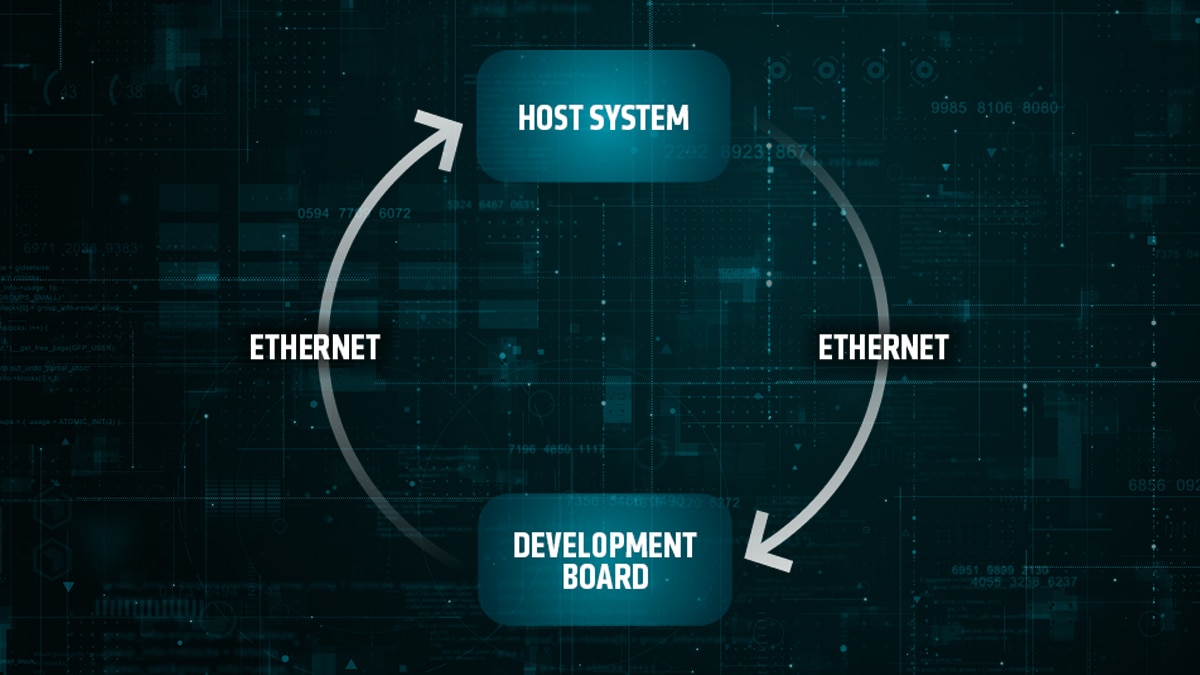
Using Vitis hardware-in-the-loop capabilities, a Vitis subsystem is packaged with a lightweight server that runs on the target Versal device. A host system communicates with this server over Ethernet, sending test vectors and receiving results for analysis. Data from the host can be passed using either MATLAB or Python, both commonly used for algorithm development.
Unlike hardware emulation, computation is performed on real silicon. This eliminates the need for cross-simulator synchronization and allows performance, timing, and numerical behavior to be measured accurately. At the same time, the software-driven nature of the flow preserves repeatability and observability.
Hardware-in-the-loop testing enables developers to validate subsystem behavior and performance before integrating the design into a complete system, reducing risk at a critical stage of development.
Reducing Risk Through Progressive Verification
By structuring verification around functional simulation, XSIM-based subsystem simulation, and hardware-in-the-loop execution, Versal device developers can avoid the cost and complexity of hardware emulation when it is not required.
Each stage addresses a specific class of risk and builds confidence incrementally. Functional simulation validates algorithms. Subsystem simulation validates integration. Hardware-in-the-loop validates real-world execution.
This approach enables faster iteration, earlier insights, and more predictable system-level outcomes.
Wrap-up
As Versal adaptive SoC designs continue to grow in complexity, verification strategies must evolve beyond reliance on hardware emulation alone. While hardware emulation remains valuable, its complexity and performance limitations make it less suitable for early-stage and iterative verification.
The Vitis Unified Software Platform provides a set of complementary simulation and verification flows that address these challenges. Functional simulation, XSIM-based subsystem simulation, and hardware-in-the-loop verification together form a scalable and efficient system-level verification strategy for Versal designs.
By applying these flows progressively, you can reduce risk, improve confidence, and accelerate the path from algorithm development to hardware deployment.
Resources
If you would like more information on the techniques mentioned in this article, the following resources will help.
- UG1701 VFS Documentation
- Vitis-Tutorials VFS Examples
- Vitis Functional Simulation Early Access Lounge (for a new C++ Flow; AMD is aiming for this to be in production in 2026.1)
- Hardware in the Loop Early Access Lounge


Related Blogs
-
Day 0 Support for Muse Spark Open on AMD
AMD is excited to announce Day-0 support for Meta’s latest Muse Spark Open model family on AMD Instinct™ MI350X and MI355X GPUs
October 15, 2026
-
Introducing FastFlow SDK
Explore AMD FastFlow-SDK for local AI development on AMD Ryzen™ AI NPUs, from running models to customizing inference and optimizing operators with FastFlow, IRON, and HRX.
October 15, 2026
-
MiniCPM Day 0 Support Across AMD Hardware
Explore Day 0 support for MiniCPM-V 4.7 on AMD Radeon™ GPUs, Ryzen™ AI Max processors, and Ryzen™ AI NPUs for on-device AI inference.
October 14, 2026
-
Kimi K3 on AMD Instinct GPUs with TokenSpeed
TokenSpeed delivers fast, agentic LLM inference on AMD Instinct™ MI355X GPUs, with optimized kernels and leading Kimi K3 performance.
October 09, 2026
-
scikit workloads with AOCL Data Analytics
Accelerate supported scikit-learn workloads with AOCL-Data Analytics while keeping your existing Python code and familiar scikit-learn APIs.
October 09, 2026
-
MoRI UMBP Empowers AMD Instinct GPUs
See how UMBP, MoRI and SGLang optimize KV cache reuse to boost AMD Instinct™ MI355X GPU agentic AI performance and cost efficiency
October 09, 2026
-
Rapid Validation on AMD Versal Silicon without Leaving MATLAB or Python
AMD Vitis™ Hardware in the Loop (Vitis HIL) bridges simulation and hardware bring-up by enabling system-level verification on evaluation hardware directly from existing MATLAB® or Python™ test environments.
October 07, 2026
-
Completing the GPU Performance Picture: Understanding TAF Alongside Peak FLOPs and MAF — ROCm Blogs
Learn how Typical Attained FLOPs complements Peak FLOPs and Max-Achievable FLOPs, including the methodology and MI325X results
October 05, 2026